
Remnant – Issue No. 6
Emptiness, it turns out, is everyone's project right now. There are vacant houses across the globe everywhere, and almost everyone in charge has decided it is a problem worth real money to solve. They just disagree, fascinatingly, about how.


Three cheap stone houses in Greece — Lesvos, Crete and Pelion, all under €20,000 — plus Greece's new housing strategy and the Golden Visa reality for buyers.
On June 19, Greece released a National Housing Strategy for public consultation and, in the fine print, named the size of its own emptiness: roughly 800,000 vacant homes the government wants to coax back onto the market. It was not alone. The same week, China published a five-year plan to modernize and refill its countryside; Azerbaijan reported tens of thousands of people moving back into villages it is rebuilding from rubble; a Chinese province described funding scores of young architects to restore its emptying villages; and Maryland and Connecticut each put tens of millions of dollars toward dragging blighted, abandoned properties back into use as housing.
Emptiness, it turns out, is everyone's project right now. There are vacant houses across the globe everywhere, and almost everyone in charge has decided it is a problem worth real money to solve. They just disagree, fascinatingly, about how.
We will get to that disagreement at the bottom, because it is pretty interesting — the American approach and the Italian approach are nearly opposites, and there is a war-rebuilt version and a top-down version too. But first, the houses. This week we are in Greece, with three doors you could in theory walk through for under twenty thousand euros: a stone house on Lesvos, a 1946 place in eastern Crete with its birth year carved over the lintel, and a 56-square-meter house in a mountain village above the Pagasetic Gulf. As always there are practical details, a comparison of who's refilling the world and how, two recipes, what we're reading, and a look at our group chat.
Lesvos
Pictured: Ampeliko, with Vatera beach to the south
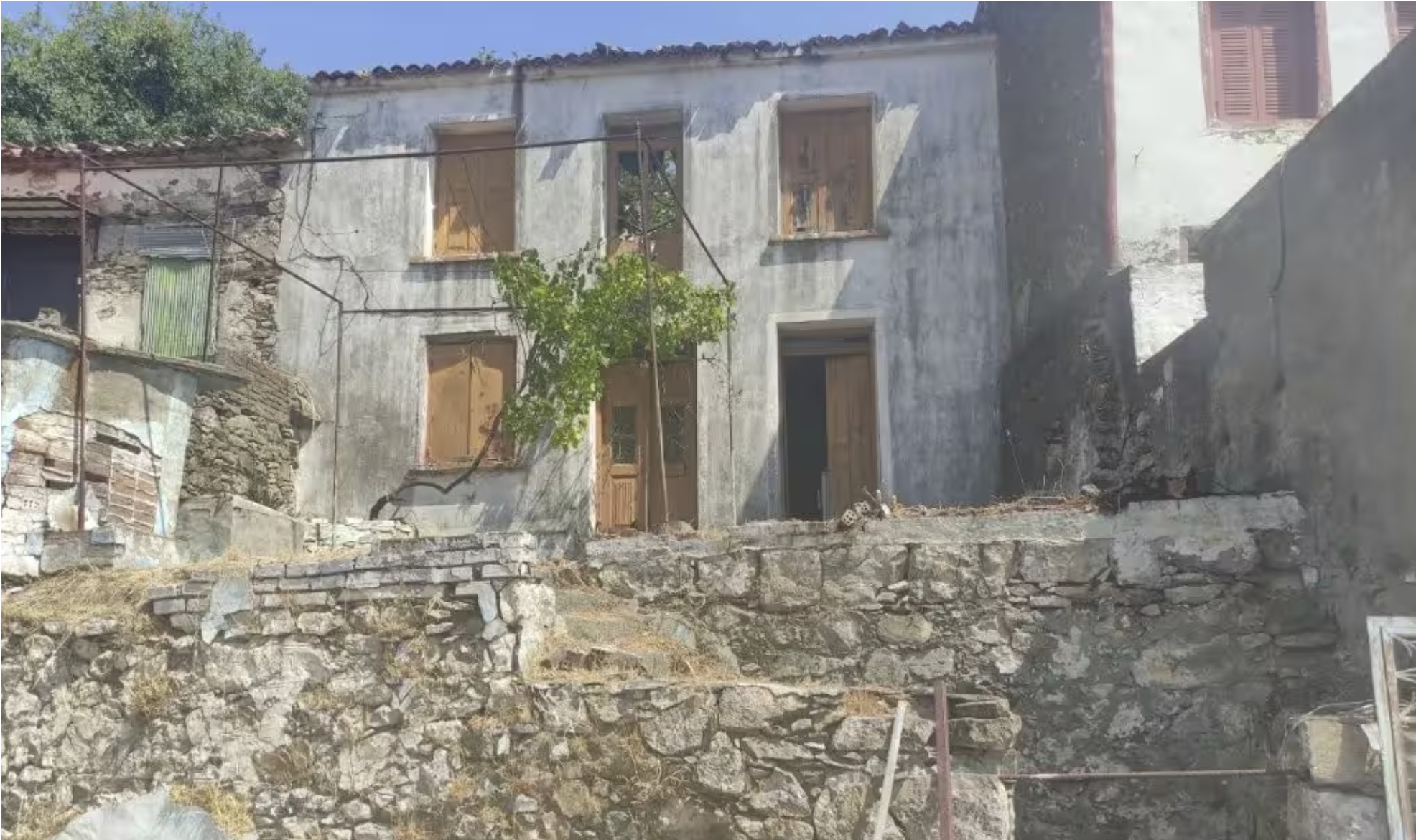
Featured: the island stone house twenty minutes from the Aegean's warmest water
Ampeliko, Lesvos — about €15,000 ($17,209), full renovation
Ampeliko is a village in the hills of Lesvos, the big island in the northeastern Aegean that sits closer to Turkey than to the Greek mainland. The house is a classic two-story stone village home, the kind the island is built from: about 33.76 square meters per floor, roughly 67.5 square meters of living space in total, on a small plot of around 80 square meters — enough for a courtyard or a tight Mediterranean garden.
This is also, for the record, Sappho's island. The archaic Greek poet was writing her love lyrics here around 600 BCE, on this same rocky ground, and it is from Lesbos — and from Sappho — that the word "lesbian" comes. You would be buying a ruin in one of the oldest literary landscapes in Europe.
It sits on the village's main road, which means year-round access. A topographic plan already exists – good news, because it shortens the first stretch of the permitting process. The lot looks onto a nearby forest rather than another wall, so you get a cooler microclimate through the long Greek summer. And Vatera — a nine-kilometer sand beach with some of the warmest, cleanest water in the northern Aegean — is about thirteen kilometers away, a twenty-minute drive. Mytilene's airport, with seasonal connections to Athens, Thessaloniki and parts of Europe, is roughly an hour out.
The first catch obviously that this is a full renovation, not a move-in house. There is also a second, less obvious catch that applies to non-EU buyers on this particular island, and we have given it its own note in The Fine Print, because it is worth understanding before you fall in love. Spoiler – it involves special permitting from the Ministry of Defence.
→ See the listing (properstar)
Crete
Pictured: Neapoli, Lasithi
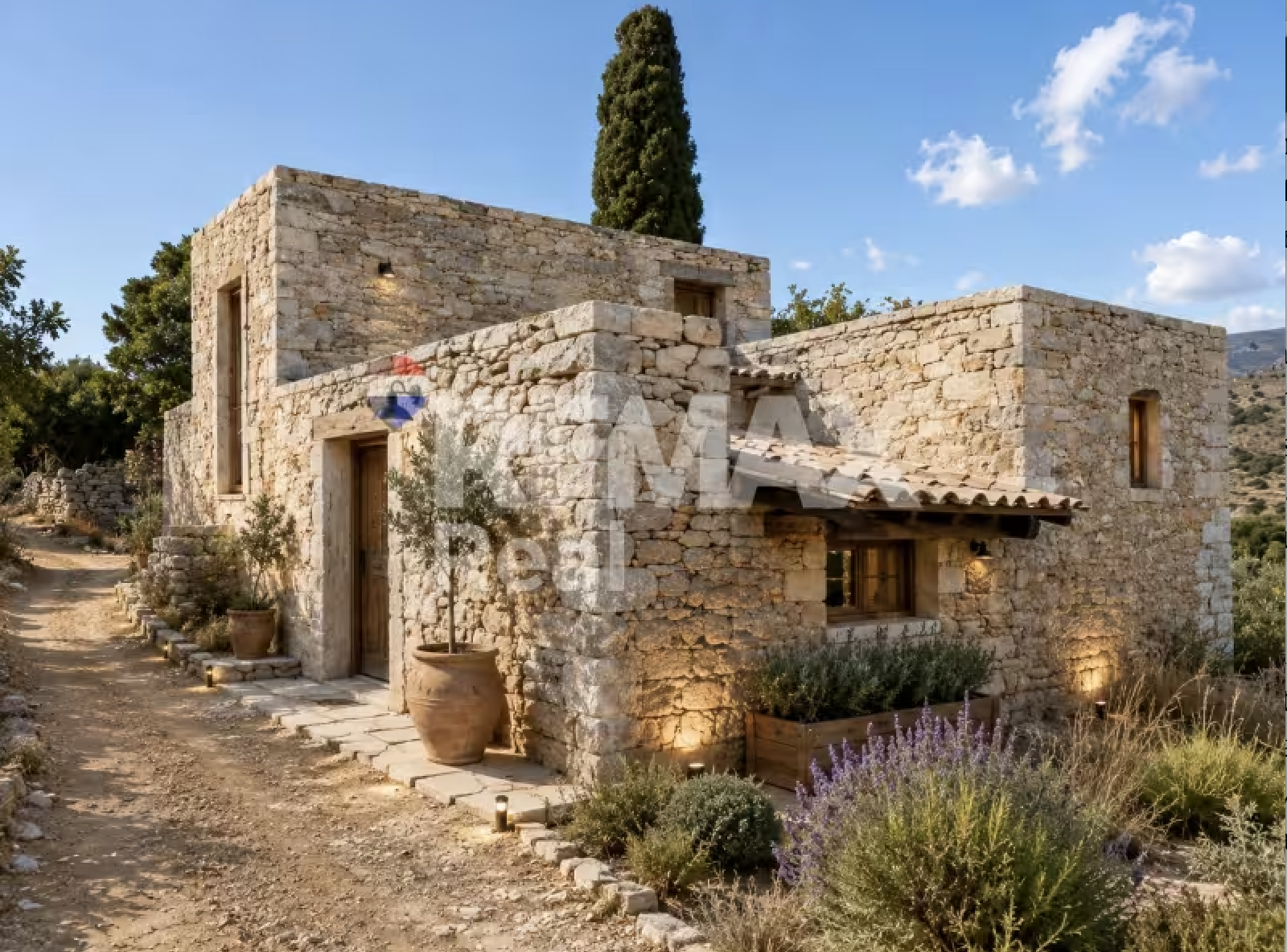
More: the 1946 stone house with its birth year carved over the door
Peronides, Neapoli (Lasithi), Crete — about €15,000 ($17,209), full renovation
This one is in Peronides, a neighborhood of Neapoli, a traditional town in the Lasithi region of eastern Crete. The house is a stone-built residence with a date carved above the main entrance — 1946 — which tells you both its age and the kind of craftsmanship it came from, the work of local stonemasons. There is an authentic carved-stone water trough by the door.
It needs everything. The listing is plain about it: the stone walls need reinforcing, the traditional ceilings — made of olive-tree logs — need replacing, and the original wooden window frames need to go. One note about the photos: they are renders, design proposals for what the place could become, not pictures of what is there now. Read them as a vision, not an inventory. Location-wise it is well placed for a project this remote-feeling: about 14 kilometers from the seaside town of Agios Nikolaos and 42 kilometers from Heraklion's international airport.
As with Lesvos, parts of Crete fall under the border-zone rule for non-EU buyers — see The Fine Print. Worth a lawyer's check on the specific plot before you get attached.
→ See the listing (properstar)
Pelion
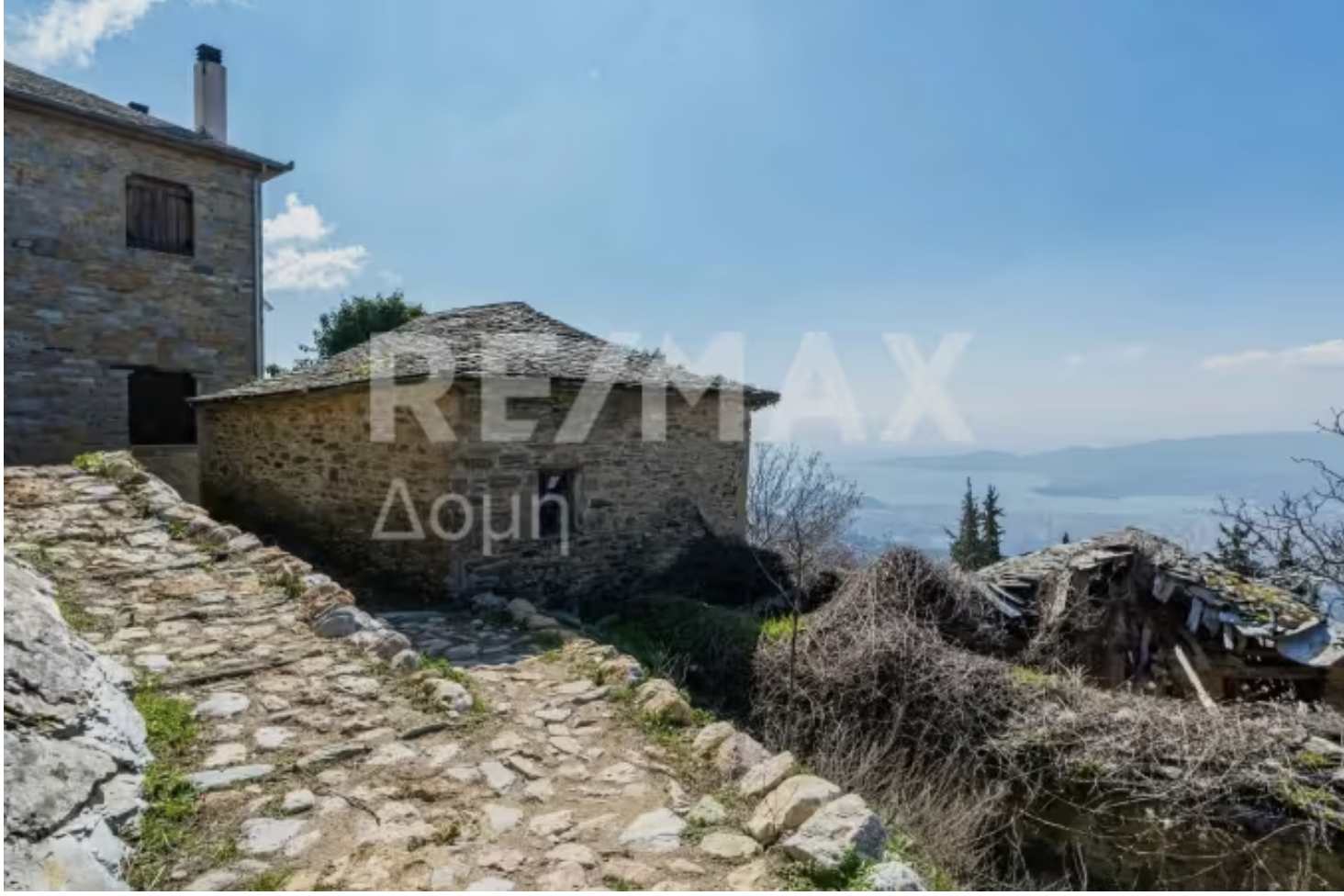
Pictured: Makrinitsa, above Volos and the gulf
More: the balcony village above the gulf
Makrinitsa, Pelion (Thessaly) — €20,000 ($22,945)
For contrast, here is a mainland house in a completely different Greece. Makrinitsa is known as "the balcony of Pelion" — a protected traditional village of old mansions, plane trees, and cobbled lanes spilling down the Pelion mountainside above the city of Volos and the Pagasetic Gulf. It is one of the most photographed villages in Thessaly, all stone houses and running fountains and views straight out over the water.
The house is 56 square meters, built in 1955, with an unobstructed view, wooden window frames, a garden, and open space around it. (If you pull up the listing and see it described as being on the "23rd floor," ignore that — it is a data-entry glitch on a single-story village house; there is no 23rd floor in Makrinitsa.) Because it is on the mainland and nowhere near a border, it does not trigger the defense-ministry permit that the two island houses might.
→ See the listing (properstar)
The Fine Print
A few things from our research this week, in case you want to keep going.
Greece's new housing strategy is openly trying to refill the country. On June 19 the government released its National Housing Strategy 2026–2035 for public consultation. The headline measures: a national property-and-rent index that could be used to set maximum rent ranges for low-quality or energy-inefficient housing; a permanent version of the "My Home" program offering cheaper mortgages to young and lower-income buyers; and reduced VAT for social and affordable construction. The whole thing is built around pulling a chunk of those vacant homes back into use.
The Ministry of Defence rule that catches non-EU buyers off guard. Here is the one most listings skip. In designated border and strategically sensitive zones, non-EU and non-EEA buyers must obtain a permit from the Greek Ministry of National Defence before they can complete a purchase. Those zones include the eastern Aegean islands closest to Turkey (Lesvos and Chios among them), the Dodecanese, parts of northern Greece, and parts of Crete. In practice the permits are almost always granted, unless there is a genuine security concern — but it is a real step, with real paperwork, and you want to know about it before you sign anything. Two of this week's three houses sit in potentially affected areas: the Lesvos house, and possibly the Lasithi one in Crete. Makrinitsa, on the mainland, is clear. EU citizens are exempt everywhere. Have a Greek property lawyer check whether your specific plot is in a restricted zone.
When a property portal says "€1," read twice. We owe you a warning here, because we nearly featured two "one-euro" Greek listings that are nothing of the sort. On the big aggregators, a property sometimes displays €1 (or $1) not because it costs a euro but because the agent selected "price on request." We found a fully furnished 805-square-meter villa near Thessaloniki — heated pool, elevator, marble everything — sitting at "€1," and a brand-new villa in Sithonia whose own description said €720,000 while the headline still read €1. The Italian-style one-euro programs we covered in issue 5 are real and wonderful, but they live in town-hall notices, not on commercial portals. Don't get sucked in by the promise of a house for a mere coin. Sort by real price and read the description for accuracy.
On being a foreigner. Greece lets non-residents buy property; there is no general nationality bar (the border-zone permit above is the main exception). You will need a Greek tax number (an AFM) and a local lawyer and notary, and you will pay transfer tax and fees on top of the purchase. BUT, like Italy, buying a house does not give you the right to live in Greece. Ownership and immigration are two separate systems, and a deed answers only the first. We are an information aggregator, not a relocation service — when we cover a country in depth we round up the visa pathways so you can see them in one place, but the immigration question is its own piece of work.
The Golden Visa is real, but it is not the cheap-house route. The headlines about Greece's "investor" residence permit can blur into the headlines about cheap Greek houses, so let us separate them. The Golden Visa now starts at €250,000 — and only for commercial-to-residential conversions or heritage restorations — rises to €400,000 across most of the country, and reaches €800,000 in Athens, Thessaloniki, Mykonos, Santorini, and any island over about 3,100 people, with the upper two tiers requiring at least 120 square meters of living space. None of this week's houses come within sight of that. A €15,000 stone ruin on Lesvos buys you a deed, not residency. If the investor route ever did get real for you, the single most useful thing we found this week is not a law firm's brochure but a recent applicant's own write-up of the whole ordeal (see the Reddit thread in the reading list below): the real processing time runs past twelve months, not the "six months" the promotional sites still quote; the big relocation companies quoted him €30,000 when a local lawyer, accountant, translator and notary together came to under a third of that; and short-term Airbnb letting is now barred for Golden Visa holders. We aggregate what's out there; we don't give advice. But if the visa question turns serious, start with the people who have actually done it.
How to actually browse Greece. The Greek market does not live on idealista the way Italy does. The portal a recent buyer told us was "enough" on its own is Spitogatos (full English interface); Spiti24 is the other domestic one, and a lot of the cheap rural stock surfaces on international aggregators like properstar (where all three of this week's houses are listed) — with the €1 caveat above. Two pointers from that same firsthand account, both worth their weight: on any house over fifty years old, check for lead water pipes and paint and for asbestos insulation, and bring a civil engineer to the viewing; on newer builds, check the Energy Class rating, because it drives the power bill. As ever, a browser translator handles the Greek-only pages, and a local lawyer is the difference between a romantic idea and a clean title.
Lifestyle & Culture Notes
Who's Trying to Refill the World Right Now — and the Very Different Theories of How
The same problem is sitting on a lot of desks this month: too many empty buildings, too few people in the places that hold them. What's striking, reading the week's news side by side, is that nobody agrees on the fix. Here is the same emptiness problem being troubleshot five different ways.
Greece — change the rules until the houses fill themselves. The theory: don't give anything away; adjust the incentives until owners and buyers do the work. The strategy leans on cheaper mortgages for young buyers, a Golden Visa rewired to reward long-term rentals, rent ceilings on the lowest-quality housing, and a VAT break for affordable construction. The bet: the homes already exist, so the job is just to put them back into use.
Italy — give the house away and dare you to fix it. The theory: the building is worth less than the person who will restore it, so sell it for one symbolic euro and let the renovation be the real price. (Our whole issue 5.) The bet: romance plus a renovation deposit will do what subsidies can't.
The United States, the institutional way — fund the cleanup, hope repopulation follows. The theory: don't pay the person, pay to fix the property. Maryland just put $77.3 million into its State Revitalization Programs for the coming year — home-rehab incentives, façade grants, demolition, a vacant 19th-century jail turned into something useful — and claims about $17.90 of economic impact per dollar spent. Connecticut released $15.2 million to clean up twelve blighted, polluted parcels so they can become housing again: a shop empty for 35 years slated to become 16 affordable condos, an old clock factory headed the same way. The bet: clean up and de-risk the property, and the rest of the chain follows on its own — developers move in, the housing gets built, and the people come back to fill it.
The United States, the rare direct way — pay the person. The theory: skip the property entirely and write a check to a human who shows up. It is the exception in America, but it exists: Tulsa Remote pays remote workers about $10,000 to move to Tulsa for a year (more than 3,500 have taken it); Ascend West Virginia offers $12,000 cash inside a package worth over $23,000 with perks and coworking; Noblesville, Indiana, runs a roughly $15,000 relocation deal through MakeMyMove. The bet: a person with a remote salary is worth more to a town than any building.
Azerbaijan — rebuild from rubble. The theory: when the villages were destroyed, refilling means reconstructing them first. The "Great Return" program is resettling formerly displaced families into war-emptied districts of Karabakh — tens of thousands moved back so far, "smart villages" built from scratch, a stated aim of returning some 700,000 people by 2030. The bet, and the hard part: you can rebuild a village faster than you can clear the landmines around it, which is why this one is measured in decades.
China — refill from the top. The theory: treat the countryside as national infrastructure. The new 2026–2030 five-year plan sets binding targets for grain output, pushes AI and modern logistics into farming, and frames "urban-rural integration" and rising farm incomes as the way to keep rural China populated. The bet: plan and invest at a scale only a central government can, and people stay.
And one more fascinating footnote, because it is the closest of all to what this newsletter actually is: Fujian province, in southeastern China, has put in the equivalent of more than $100 million to bring young architects and creative professionals — many from Taiwan — into its emptying villages to restore them, with about 190 such teams now at work there. People, paid to move into empty places and bring them back to life. Remnant is documenting what looks like a global movement to elevate quality of life in areas that have been long neglected and sidelined.
The throughline: Europe tends to deal directly with the person (give them the house, change their incentives), America mostly deals with the property (clean it, fund it, and wait), and the harder cases rebuild or plan from above. Five theories, same vacancy issues. Somewhere in there is a house with your name on it.
Recipes from the Map
Two dishes from two of this week's islands, both of which derailed an afternoon of research.
From Crete, dakos — the barley rusk that is basically Crete in a single bite. You moisten a hard round of barley rusk with olive oil, pile on coarsely grated ripe tomato, crumble fresh mizithra or feta over the top, and finish with oregano and a slick more of good oil.
From Lesvos, grilled Kalloni sardines — the island's pride. The sardines from the Gulf of Kalloni are famous across Greece; locals salt them lightly and either grill them whole over coals or eat the freshest ones cured, with ouzo from Plomari at the other end of the table.
What we're reading
Six things from our tabs this week.
- "Door opened" for rent caps, cheaper mortgages, a new Golden Visa and reduced VAT, via Protothema. The actual contents of Greece's new National Housing Strategy, including the line about ~800,000 vacant homes and the proposed long-term-rental Golden Visa.
- One person's actual Greece Golden Visa journey, start to finish, via r/ExpatFIRE. The write-up the immigration industry would rather you skip: a recent applicant logs every real step of the real-estate Golden Visa — the power of attorney that lets your lawyer pull money from your bank account, a land registry so backlogged it's measured in years, the €30,000 firm quote he refused, the twelve-months-and-counting wait. If the investor route ever gets serious for you, read this before you read anyone's sales page. It's also generously footnoted — including Greece's official Golden Visa white paper (the author's "read it before doing anything") and a plain-language rundown of the new rules, via Athens Law Office.
- Inside Azerbaijan's "Great Return" project, via News.az. The most literal repopulation story going — rebuilding and resettling war-emptied villages, landmines and all.
- Young people from Taiwan build a future in mainland villages, via Xinhua. The $100-million-plus program paying creatives — about 190 teams of them — to restore emptying villages, the state-funded cousin of what we do here.
- Maryland announces $37 million for community development in its central region, via Maryland DHCD. The American institutional model in one press release: rehab incentives, façade grants, a vacant jail reborn.
- "Renters, this is your year", via Moneywise. The cold-water counterweight: US rental vacancies hit a multi-year high and 40% of landlords are offering concessions — and yet rents are still about four and a half times their 1980s level. Even a softening market is still the expensive option. Which is, more or less, why this newsletter exists.
Live from our group chat
This is the part where we let you eavesdrop on the week's rabbit hole.
Malia: There's a stone house on Lesvos for fifteen thousand euros, twenty minutes from the warmest water in the Aegean, and the only thing standing between me and it is the Hellenic Ministry of National Defence. Guess I'll just have to prove that espionage is not one of my hobbies...
Wally: They almost always grant it. You file a form, a committee confirms you are not a strategic threat to the eastern Aegean, and then you are simply a person who owns a house with no roof. The Ministry and the roof are, in that order, your two problems.
Malia: The permit, the roof — mere details. Eight hundred thousand empty houses and a whole national strategy to fill them? At this point Greece is just subtweeting us.
Wally: Meanwhile the "one euro" villa outside Thessaloniki turned out to have a heated pool, an elevator, and a fifty-thousand-euro marble sink. The euro listing price was a sneaky placeholder. The sink was load-bearing. The lesson, every week, is read the description.
That is issue six. Thanks for reading.
Until next week, Wally & Malia
Remnant is a weekly newsletter about distressed and beautiful houses around the world. We are not real estate agents. We just got a little obsessed and started digging. What will you do with what we find?