
Remnant –– Issue No. 14

A seven-room farmhouse in Japan's folklore capital for three thousand dollars, a license to catch a river spirit, and the aerospace engineer who quit airplanes and took a town from ten visitors a year to four hundred...
We're aiming for short and sweet this week – in Japan. We encountered an article about Daisuke Fujii, who as a young person wanted to build airplanes. He grew up in Saitama, one of five children, went to the National Defense Academy for aerospace, graduated in 2002, and got the job, which lasted about two years until funding disppeared and he moved over to the auto industry. But he didn't stop there.
On August 9th, Business Insider ran his account of his next move. He went to Texas. His line about it: "From Texas, I saw how cities all across the United States were growing thanks to venture capital companies. In Japan, only Tokyo and Osaka were growing."
So in 2009 he cofounded a company called Farm & Firm, which helps rural Japanese towns work out how to make their own money. Ten employees in 2011, eighty now. One of the projects is a two-hundred-year-old farmhouse in Nakagawa, a town in Tochigi with under twenty thousand people. It had been an akiya, an empty house. It's now known as Iizukatei, four buildings inside an Edo-era stone wall, two houses and two earthen storehouses. Nakagawa used to see ten or fifteen international visitors a year. It now sees four or five hundred.
Four more things landed on our desk that also seemed worth contemplating. Boulder County's farms are losing workers because the only dwelling its zoning permits on agricultural land is a single-family house. A program in Ukraine is taking applications until 26 August from small towns that have an abandoned municipal building and want to house displaced families. A permanent secretary in St Kitts told a public meeting that roughly 60 percent of the houses in one village are unoccupied. And Argentina's Senate spent Thursday night arguing about who private property belongs to, with tear gas outside. They are all in the reading list.
So what actually stands between an empty house and a person who could live in it? In Nakagawa it was one man with a mission, some international inspiration, and a business plan. In Boulder County a farm is allowed one house for a worker, and only if the owner is living on the land too.
Anyway. We went to Japan with it. Three houses this week, all wooden, one of them a seven-room farmhouse for five hundred thousand yen in a town that sells licenses to catch river spirits. Also two recipes, the reading list, and our silly group chat.
Japan
Three houses this week, all listed through Akiya Hopper, which aggregates Japanese vacant-home listings into English. Worth knowing before you click: the site notes that some listing information has been extracted or summarized using AI and may be incomplete.
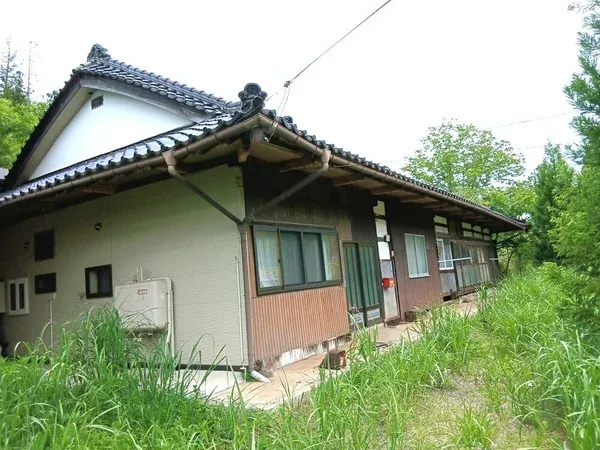
Featured: seven rooms, a thousand square meters of land, and a folklore problem
Miyamori, Tono, Iwate · ¥500,000 (~$3,100) · 167.76 m² on 1,004 m² of land
Tono sits in the mountains of inland Iwate, in the northeast. In 1910 the folklorist Kunio Yanagita published Tōno Monogatari, 119 stories he had heard from a local man named Kizen Sasaki, and the book turned the valley into the address of Japanese folklore. Kappa, the river creatures. Zashiki-warashi, the child spirits who live in the good room of a house and take the household's luck with them when they go. Yanagita later retired to Tono himself.
Tono also grows hops, more of them than anywhere else in Japan, and holds a harvest festival for them every August.
The house is 167.76 square meters, wooden, laid out as a 7DK, which is seven rooms plus a dining-kitchen. It sits on 1,004 square meters of land, is on public water and sewerage, and has parking. Five hundred thousand yen is about $3,100 at the rate this week, roughly a month and a half of rent on a one-bedroom in Los Angeles, for a house with seven rooms and a quarter acre.
Two things the listing does not tell you. The first is the year it was built, which is left as unknown, and in a wooden house in snow country that is the number you most want. Tono runs below minus ten in winter with around thirty centimeters of snow, and Japanese building code changed materially in 1981 on earthquake resistance. The second is condition, beyond the word akiya, which in Japanese listing practice means vacant and expects renovation rather than promising a move-in.
Miyamori is worth understanding as a place. It was its own village until 1 October 2005, when it merged into Tono with about 5,162 residents spread across 165 square kilometers. The property is roughly seven minutes by car from Miyamori Station, twenty-one from the center of Tono, and thirty-four from Hanamaki Airport.
One local piece of architecture to look up while you are in the tab: the Nanbu magariya, the L-shaped farmhouse of Iwate and Aomori, where the horse stable is attached at a right angle to the main house so the animals stay warm through the winter. Rice was difficult in Tono, so families lived on silkworms, charcoal and horses, and the heat from the cooking stove in the earth-floored work room carried through to the stalls. This house is not one of those, but Tono Furusato Village has several that are still standing.
More from Japan
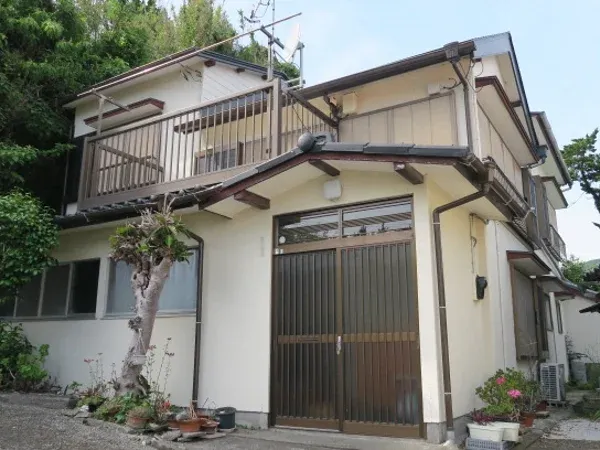
Shirahama, Shimoda, Shizuoka · ¥5,000,000 (~$31,000) · 129.68 m², built 1958
Shimoda is at the bottom tip of the Izu Peninsula, and it is where Commodore Perry's Black Ships came in, which makes it one of the first two Japanese ports opened to American vessels in 1854. Shirahama is its beach, eight hundred meters of white sand with a shrine sitting on it, four or five kilometers east of Izukyū-Shimoda Station. The house is about thirteen minutes from that station and was built in January 1958. Wooden, 5LDK, five rooms plus a living-dining-kitchen.
The building is 129.68 square meters. The land is 67.76. The house is stacked, and it takes up its whole lot – no parking. On a peninsula where everything is spread along one coast road, you would have to do the research as to where the car lives.
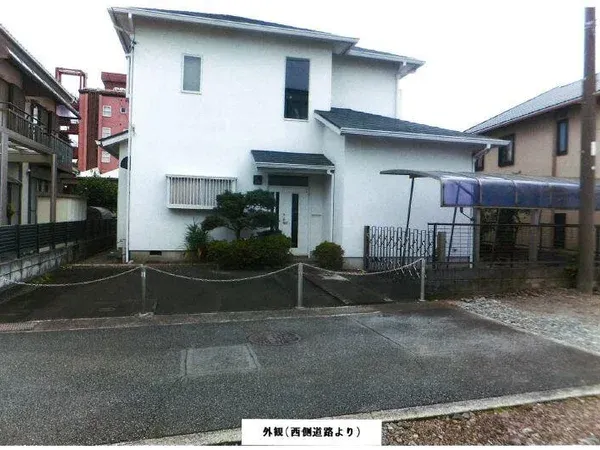
Denpō, Fuji City, Shizuoka · ¥16,000,000 (~$100,000) · 130.4 m² on 222.44 m²
The splurge of the week, and the one you could plausibly move into. 130.4 square meters, wooden, 6DK, on city gas and sewerage, with a working toilet, parking, and full ownership of the 222 square meters underneath it. Seven minutes from Yoshiwarahoncho Station. The listing puts the all-in cost, taxes and fees included, at about ¥17,970,000, or roughly $113,000.
Yoshiwara was the fourteenth station on the old Tōkaidō road between Edo and Kyoto, and it is famous among people who look at Japanese prints for a geographic accident. The road bends there. For that stretch, Mount Fuji appears on the traveler's left instead of the right, and the spot is called hidari Fuji, left Fuji. Hiroshige put it in the Fifty-three Stations series. You would be living about seven minutes from it.
The Fine Print
What a ¥500,000 house costs
Not ¥500,000. Japanese property purchases carry a brokerage commission, which Akiya Hopper puts in a range of ¥27,500 to ¥330,000 on listings at this end, plus registration and license tax, judicial scrivener fees for the title work, and a buyer's agent fee if you use someone to handle an acquisition from overseas. On the Fuji City house the site's own all-in estimate runs about ¥1.97 million above the asking price, which is a useful ratio to carry into any of these.
Then there is the annual side, koteishisanzei, the fixed asset tax, and in most cases a city planning tax on top of it.
Lifestyle & Culture Notes
Permit No. 220
In Tono you can buy a license to catch a river spirit. It costs 220 yen.
You buy it at Denshōen, the folklore museum, or from a man in a wide-brimmed hat down at the water. It comes with a bamboo pole already baited with a whole cucumber, because kappa are understood to prefer them, and a list of seven rules. Kappabuchi is a green pool in the woods behind a temple. The Tono Tourism Association has said it will pay ten million yen to anyone who brings in a captured kappa, which is a bit over sixty thousand dollars at this week's rate, and twenty times the price of the farmhouse above.
Nobody's collected yet... You sit there anyway, holding a stick with a cucumber on the end of it, in a town that wrote its ghosty folklore down in 1910 for posterity. It is a very good hour.
Recipes from the Map
Jingisukan via RecipeTin Japan — grilled lamb, and one of Tono's local dishes. Cooked on a domed cast-iron skillet so the fat runs down into the vegetables banked around the rim.
Kinmedai nitsuke via Just One Cookbook — the deep-water fish Shimoda is known for, simmered whole in soy, sake, mirin and sugar. Twenty minutes, one pan, no browning.
What we're reading
- I spent 15 years chasing my dream of designing planes. I gave it up to help revive rural Japan., Daisuke Fujii as told to Laura Pollacco, Business Insider, 9 August 2026.
- Inside Iizukatei, a 200-year-old home turned boutique hotel in Tochigi, The Japan Times, 13 April 2026. What the akiya in the essay above actually became.
- Boulder County farms struggle to keep workers. Could tiny homes help?, Boulder Reporting Lab, 6 August 2026. About 125 producers work 25,000 acres of county open space, and the hired farmworker count fell from over 1,200 to 588 in five years. Agricultural zoning permits one kind of dwelling out there, a single-family home, and the county is finally studying whether to allow anything else.
- Transforming abandoned buildings for social housing in Ukraine, FundsforNGOs. U-LEAD with Europe is taking applications until 26 August from Ukrainian towns under 50,000 people that own an abandoned municipal building and want to turn it into housing for displaced families. Renovation support, volunteers and management training come with it.
- Government officials highlight abandoned property issues in St Kitts, WINN Media. Roughly 60 percent of the houses in Challengers are unoccupied and whole streets sit empty in Saddlers, blamed on migration, inheritance disputes, building costs and storm damage nobody could afford to repair. The inheritance mechanism is the one we looked at in Issue 13, with hurricanes attached.
- Argentina Senate passes revised property rights bill, teleSUR English. The Senate passed it 37 to 33 early Friday and it goes to the lower house next. The Buenos Aires Times has what came out to get it through, including the caps on foreign land ownership.
Live from our group chat
What the rabbit hole looked like for us this week.
Malia: I read that Tono keeps a camera on a pool in the woods around the clock in case a kappa surfaces.
Wally: In case.
Malia: The old farmhouses there are L-shaped so the horse lives inside with the family and the cooking stove heats its stall. Seven rooms, five hundred thousand yen. We could get a horse.
Wally: We could get a house.
That is issue fourteen. Thanks for reading.
Until next week, Wally & Malia
Remnant is a weekly newsletter about distressed and beautiful houses around the world. We are not real estate agents. We just got a little obsessed and started digging. What will you do with what we find?