Remnant – Issue No. 5
Sardinia and Calabria are the examples in this issue, but they are part of a broader pattern of repopulation grants — income support, business start-up money, symbolic rents — aimed at getting working-age people to stay and live.


They might just pay you to call it home (and work): Italy's one-euro houses + repopulation programs.
This week we are in Italy, chasing the most famous version of the idea this whole newsletter is built on: the house that costs one euro.
Let's start with the logistics of one couple who actually did it. Rae Knopik, an American, and Declan Norrie, an Australian from Canberra, applied during lockdown for a €1 house in the Sicilian hill town of Troina — a three-storey stone place believed to date to the 1400s, reportedly once part of the town's old watchtower, empty for around sixty years. They found out they'd won it through a LinkedIn message, and only later learned they had beaten roughly 60,000 other applicants for that single property. The renovation they're now facing will run about A$97,000 (roughly €60,000). As Rae puts it: "These houses are not free housing. It's a partnership with a community."
You have seen the headline. A town in Sicily or Sardinia, half its windows dark, posts a notice that the old houses in the historic center are for sale at the symbolic price of a single euro — less than the espresso you would drink while reading about it. The story travels because the number is almost rude. One euro. For a house. In Italy.
However, the euro is symbolic to the agreement between the buyers and the community. What the town is actually offering is a deal: take this stone shell off our hands, promise to restore it on a timeline, put down a deposit we keep if you walk away, and in return you get an address in a place that has been standing since before your country had a constitution. The renovation is the real cost – in time, money, and probably frustration over negotiating permits and contracts in a country that seems to almost pride itself on its notoriously slow-moving and particular bureaucracy. Nothing is free – even The Dollar Store doesn't have much these days that actually costs a dollar (or euro). But the spirit of these programs is worth contemplating, because it is genuinely a little romantic, and not necessarily impractical. The town leadership, looking at their depopulating village home, decides the answer is to give the houses to whoever is crazy enough to love and revive the house, and help bring the town back to life.
This issue we have a handful of different types of programs, each running a version based on what its community needs: Taranto in Puglia, where the one-euro houses sit on an island between two seas; Acerenza in Basilicata, a cathedral town on a hill ; and Montieri in Tuscany, proof that the wine and olive oil soaked dream region is in on this too. Then there are the two regions that skip the house and pay you directly — Sardinia and Calabria, where the deal is funds to move to a small town and build something.
Before we begin, an important note because the 'listings' section is a bit different in this one. Italy is harder to browse than Japan and Portugal. There is no clean, photo-filled, English-language catalog the way there is for akiya, and the actual euro houses don't live on a property portal at all — they can be found in each town's official notices (bandi), which we point you to at the bottom. So this issue is about the towns and how their programs work, some ways in and places to look. As usual, we've also got lifestyle notes, what we're reading, some delicious Italian recipes, and a peek at our running group chat.
Sardinia & Calabria
Featured: the regions that will (currently) pay you to show up
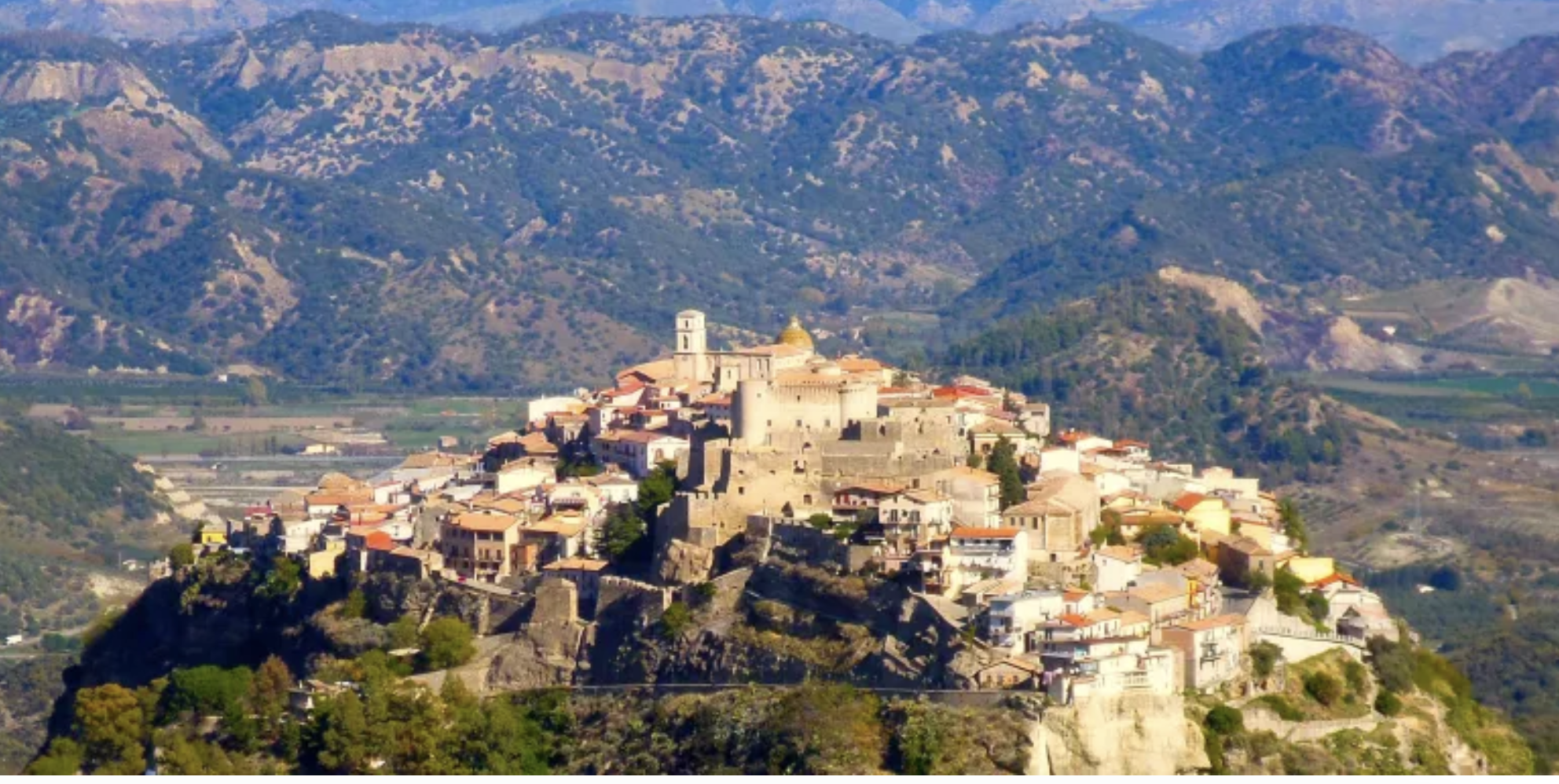
Two regions are currently implementing programs that skip the euro-house theater and instead, incentivize newcomers to become economically and socially participating community members.
Calabria, the toe of the boot, just signed one into operation in February 2026 called the Abita Borghi Montani Calabria — roughly "live in Calabria's mountain villages" — which pulls in more than sixty mountain comuni of up to 3,000 residents, each able to draw up to €100,000 from a €5 million regional pot to pay people who move their residence in, or who open and keep running a business there. The bet is deliberately broad: most of the money is set aside for new businesses, but a slice is reserved for retirees and remote workers, because a village needs all sorts. It's the kind of money that opens a café, fixes the bikes, or runs the town grocery. (Calabria ran a tighter, under-40 "active residency income" pilot back in 2021; this is the expanded, version.)
Or – move to the island of Sardinia, to a town of fewer than 3,000 residents, commit to staying at least five years, and you can claim up to €15,000 toward buying or renovating a home. Start a business there that employs local people, and there's up to €20,000 more for that. The island pays families to grow — €600 a month for a first child and €400 for each one after, until they turn five.
These aren't scams, but they require a certain willingness and ability to carpe diem. Not permanent offers, the programs run as regional and municipal bandi that open, fill, close, and reopen with new money in the next budget cycle. The place to watch is each region's bandi page — and the roundups that track them, below.
→ Sardinia's anti-depopulation grants, explained (Euronews) · → Calabria's Abita Borghi Montani villages program (Regione Calabria, Feb 2026)
Puglia
The one-euro houses by the sea (sort of)
Taranto (Città Vecchia), Puglia — €1, symbolic-price urban regeneration
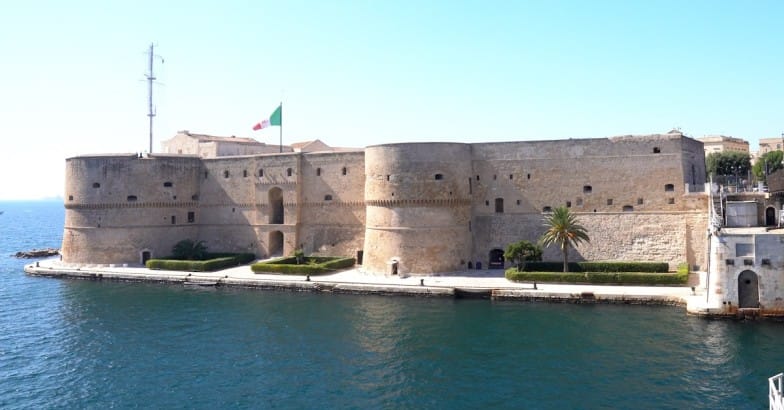
Everyone wants the one-euro house by the sea, but almost nobody gets it because the cheap houses are inland. Taranto is the closest thing going: a one-euro scheme not in a tiny village but in the old heart of a city on the Ionian Sea.
Taranto sits between two bodies of water — the open Mar Grande and the enclosed Mar Piccolo lagoon — and its Città Vecchia, the old town, occupies a narrow island, about a kilometer long and 300 meters wide, that once was an independent city ringed by sea and crowned by the fifteenth-century Castello Aragonese. In the nineteenth century the old town began emptying out, and today only a few thousand people live on the island. The city owns hundreds of properties there, and has been releasing batches of them for symbolic prices under tightly defined urban-regeneration projects — the goal being to refill the historic fabric with families, shops, and small tourism rather than let it crumble into the lagoon.
This is a tall, narrow, possibly-crumbling townhouse in an ancient island comune, where the challenge is that you commit to a real renovation within a deadline and pay all the legal and building costs. But the setting is a working southern Italian port with all that entails.
→ Browse current Taranto listings on idealista · → How Taranto's €1 old-town scheme works (idealista)
Basilicata
The cathedral town you've probably never heard of
Acerenza, Potenza, Basilicata — €1, 48-month renovation
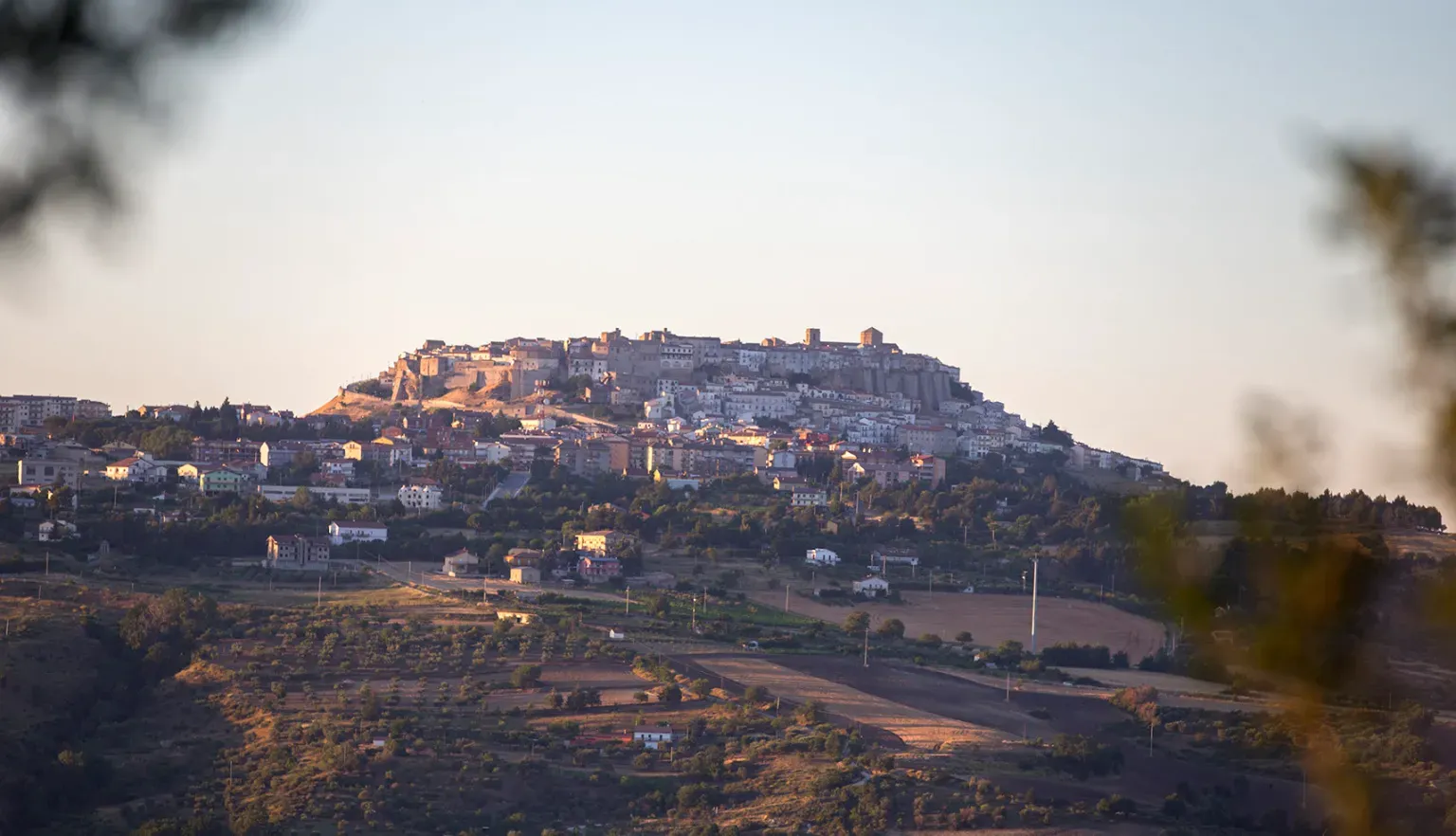
Basilicata is a region on the instep of the boot on the way to Puglia. Acerenza is a small hilltop town of under four thousand people in the province of Potenza, perched above the Bradano valley, nicknamed la città cattedrale, the cathedral town. The Romanesque cathedral that crowns it is one of the finest in the south, large and grand and a little startling for a town this size. The old center wrapped around this focal point is all narrow, twisting stone streets you'd probably rather walk than drive.
Acerenza's one-euro program runs on typical terms: the municipality acts as matchmaker between owners of abandoned houses in the historic center and buyers willing to take them on for the symbolic euro, with a commitment to renovate within 48 months. The houses are small, old, and in the kind of condition that the price implies — these are projects, not move-in homes. What you are buying, beyond the building, is a foothold in southern Italy.
→ How Acerenza's €1 scheme works (1 Euro Houses) · → Browse houses around Acerenza on idealista
Tuscany
Yes, even (che bella) Tuscany
Montieri, Grosseto, Tuscany — €1, in the region everyone dreams of
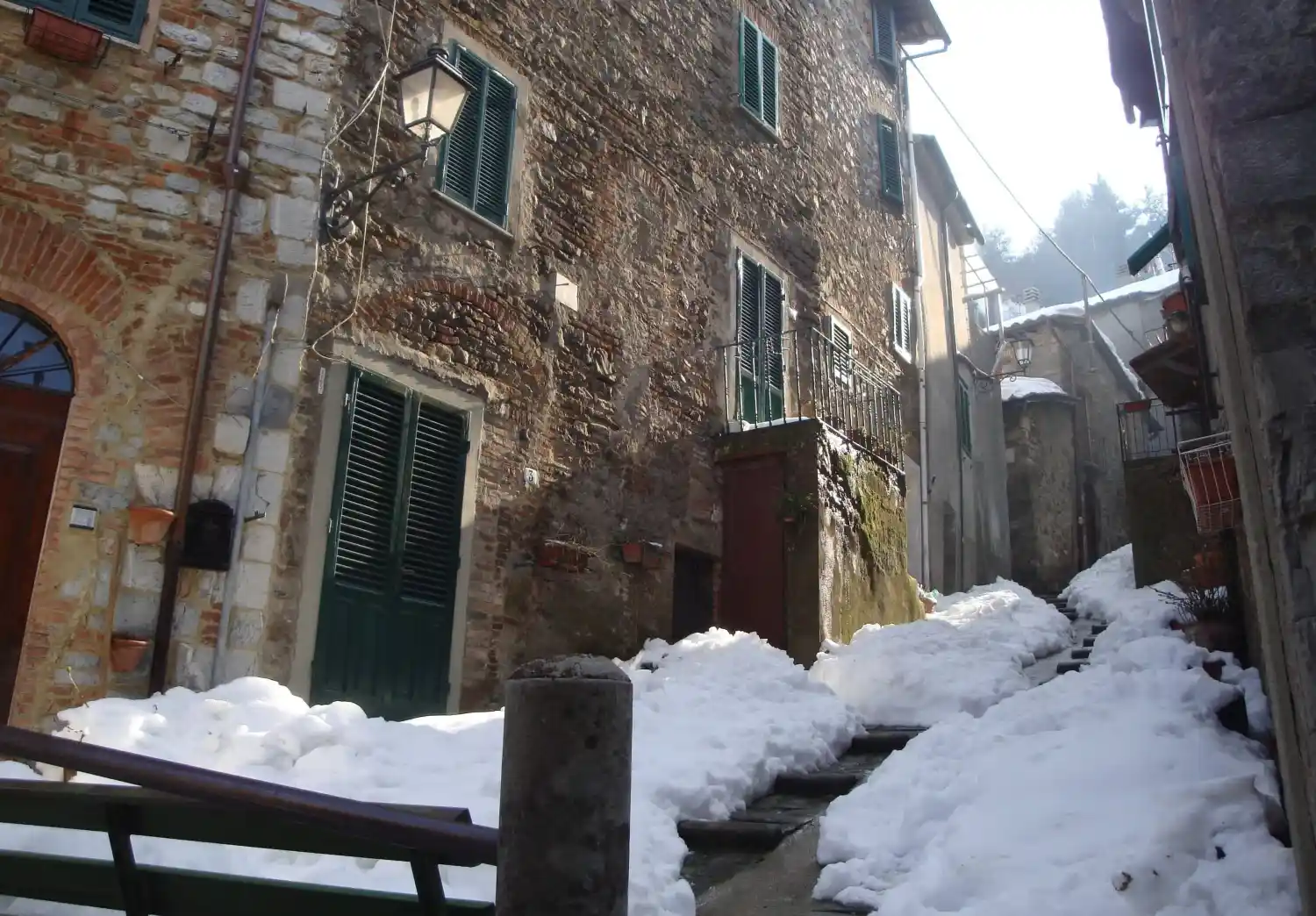
Tuscany: romanticized to the hilt, but still suffering from depopulation issues in some areas, especially the more remote hill regions. Montieri sits in the Colline Metallifere, the "metal-bearing hills" of the province of Grosseto, roughly 90 kilometers south of Florence and about 45 from Siena — an old silver mining town that now offers its empty houses for a euro to anyone who will bring them back from the brink of ruin.
Nearby Fabbriche di Vergemoli, up in the Apuan Alps of the Garfagnana, ran the same program and has now suspended it — because the houses sold out. That's the thing about these programs; the good ones seem to be worth it, and they get snapped up. Montieri is the Tuscan name to know — it has sold 15–20 houses since 2016 at a range of prices. The terms are standard— symbolic price, a renovation proposal, a deadline measured in three years (if not met, the property is returned to the original owner). But the address would be Tuscany, with the light, the cypress, the vineyards and hot springs and piazzas within easy driving distance, Siena close enough for a day trip. The catch, as ever, is that the euro buys a dump and then you pay to make it a livable home.
→ How Montieri's €1 scheme works (1 Euro Houses) · → Browse non-1 euro houses around Montieri / Grosseto on idealista
The Fine Print
A few things from our research this week, in case you want to keep going.
The euro is symbolic. Across nearly every Italian one-euro town the deal has the same skeleton. You respond to a public call (a bando) from the town council, name the property you want, and submit a basic renovation proposal with a rough budget and timeline. You put up a refundable security deposit or surety bond — commonly somewhere around €2,000 to €5,000 depending on the town — which the municipality keeps if you don't follow through. You generally must start work within a set window (often a number of months) and finish within about three years. Realistic all-in renovation costs run from the low tens of thousands into six figures depending on size and condition; a sober planning range people cite is roughly €20,000–€50,000 for a basic but real restoration, more for anything ambitious. Rae and Declan, the Troina couple from the top of this issue, were clear there were "no hidden surprises" in their roughly A$97,000 (~€60,000) renovation — they always understood it as a project, not a magical free house.
Some towns pay you instead of selling cheap. Sardinia and Calabria are the examples in this issue, but they are part of a broader pattern of repopulation grants — income support, business start-up money, symbolic rents — aimed at getting working-age people to stay and live. Really participate, not just buy. These are a different mechanism from the one-euro sale, with different rules (age limits, residency minimums, a business requirement, and application windows that open and close).
On being a foreigner. Italy lets non-residents buy property; there is generally no nationality bar to purchasing a house, and most one-euro programs explicitly welcome EU and non-EU buyers. You will need an Italian tax code (codice fiscale) for the deed, and you will pay notary and registration fees on top of everything else. The thing to say plainly: buying a house does not give you the right to live in Italy. Ownership and immigration are two separate systems, and a one-euro deed answers only the first one. We are an information aggregator, not a relocation service — when we cover a country in depth, we round up the visa pathways so you can see them in one place, but the immigration question is its own piece of work.
And — how to actually look at the houses. This is the part we especially wanted to address, because Italy is a lot clunkier to browse than Japan. As we've noted before, Italy has no central MLS — no single, shared multiple-listing database the way the US does — so the same house can appear on three agency sites at three different prices, or on none of them, while the one euro stock might live only in a town-hall notice. There is no single English catalog with tidy photos, and that is structural, not an oversight. What works: start at idealista, Italy's biggest property portal, which has a full English interface, real listings with photos and prices, and current 2026 editorial roundups — including a map of one-euro towns and a plain-language how-to-buy guide. For the actual one-euro stock, you go to the source: the town's own comune website, where the live bando and the official property list live (often Italian-only — a browser translator handles it). The aggregator 1eurohouses.com is a useful index of which towns have active programs and links back to each one. Summary: idealista for research and browsing, the comune to find the actual euro ones.
Lifestyle & Culture Notes
Four Italian Towns That Want You, Compared by What They'll Actually Demand in Return
Every one of these is somebody's screensaver. In the interest of public safety, here is the same fantasy with the fine print read aloud.
The Sardinian or Calabrian mountain village (they pay you). The romance: a region writes you a check simply to exist within its borders. The reality: the check is also a contract, and the contract has expectations. You are now the person the town is relying on to open its only general store (emporio generale). Children will be raised on the promise of that emporio generale. When you get drunk on the local vino and sleep in, the village notices. You came for a fresh start and received a job, a stake in the local economy, and roughly forty new nonnas tracking your foot traffic – and your credibility.
Taranto, on its island between two seas (€1). The romance: a crumbling palazzo on an ancient island, mussels in the water, a different sea at one end of the street, a lagoon at the other. The reality: the island is possibly haunted, certainly vertical, and your house is a narrow stone tube that has waited since the nineteenth century for someone exactly this suggestible (aka naive). You will pour your savings into rehabbing the stone steps that deliver you safely into your house. The mussels, in fairness, remain excellent throughout.
Acerenza, beneath its enormous cathedral (€1). The romance: you live in the shadow of a Romanesque cathedral far too magnificent for your present tax bracket. The reality: it is too magnificent for the town's bracket as well, which is precisely why the town is four thousand people and shrinking. You will be the local curiosity. People will know your business before you do. Then one morning, if all goes well, you are simply a neighbor, and the cathedral goes back to being the monolith in whose shadow you hang your laundry to dry.
Montieri, in the Tuscany of the calendars (€1). The romance: you paid one euro to stand in the precise light that sells those calendars of sunflowers and cypress rows. The reality: the light will not pour your foundation, and the cypress will not rewire your house. Siena is a day trip; the renovation is the remainder of your natural life. Still, you will get to tell people you live in Tuscany, they will go silent with envy, and you will simply decline to tell them your roof leaks, and your neighbors speak a language you really don't. Yet.
Recipes from the Map
Two dishes from two of this week's places, both of which made us hungry mid-research.
From Sardinia, malloreddus alla campidanese — the little ridged semolina dumplings the island calls gnocchetti sardi, tossed in a slow ragù of fennel-spiked sausage and tomato with a thread of saffron, finished with aged pecorino.
From Puglia, cozze alla tarantina — Taranto-style mussels, the city's signature, quickly opened in garlic, white wine, and a little peperoncino secco, then folded into a fresh tomato sauce with their own brine and torn parsley. Eaten with toasted bread to soak up the leftover sauce.
- Malloreddus alla Campidanese, via Inside the Rustic Kitchen
- Cozze alla Tarantina, via Memorie di Angelina
What we're reading
Five things from our tabs this week.
- How to Relocate to Italy from the US: All You Need To Know via ICA. A guide on how to move to Italy for Italian citizens, citizens of a European Union country, and non-EU citizens. They outline the visa options that are available for those looking to reside long-term in the country and the ways to acquire Italian citizenship. They also discuss how to buy property in Italy and the benefits of being an Italian resident and citizen.
- The Australian who turned a one-euro Sicilian house into a community kitchen, via Live in Italy Magazine. Danny McCubbin, a Queenslander who worked for years with Jamie Oliver in London, bought into Mussomeli for a euro, then opened The Good Kitchen to feed his adopted town.
- The Canberra couple who bought a €1 Sicilian home reveal the reality of the scheme, via news.com.au. Rae and Declan's full story — the Florence bar, the 60,000 applicants, the watchtower house in Troina, and the clear-eyed "not free housing, it's a partnership with a community" that anchors this whole issue.
- Map of one-euro houses in Italy, 2026, via idealista. A useful bookmark if you want to see which towns are running programs right now, region by region.
- The small European towns that will pay you to move in 2026, via Euronews. A current map of who's writing checks — Sardinia's relocation grants, Ireland's island-restoration money (up to €70,000), a rent-subsidy town in Tuscany, and matchmakers for rural Spain.
- The truth about one-euro houses: the hidden costs, via idealista. The cold-water counterweight to everything above, and the piece to read before you fall all the way in.
Live from our group chat
This is the part where we let you eavesdrop on the week's rabbit hole.
Malia: Okay but the regions that pay you to move there. I'd already mourned the Calabria program, figuring we aged out at 40 — then I found the new mountain-villages call that specifically takes remote workers and retirees. Wally. We're remote workers. I'm reading the bando right now.
Wally: The thing that gets me is Fabbriche di Vergemoli selling out of homes. That makes me want to jump on something in Montieri before the good ones disappear – is that crazy? Or smart?
That is issue five. Thanks for reading.
Until next week, Wally & Malia
Remnant is a weekly newsletter about distressed and beautiful houses around the world. We are not real estate agents. We just got a little obsessed and started digging. What will you do with what we find?