
Remnant – Issue No.7
If you read this newsletter, you are a person who has at least daydreamed about buying a piece of another country because it is beautiful and cheaper than home.


This week, the world measured "desirable" – from a stone smallholding to a $4-billon resort. Five rustic houses across Italy, Portugal and Japan, and the Albania debacle that holds a mirror up to everyone who reads this newsletter. Us included.
Last week the word desirable did a lot of heavy lifting in the world of real estate, at wildly different scales.
In Washington, the Senate passed something called the RESIDE Act — Revitalizing Empty Structures Into Desirable Environments — a pilot program to turn America's abandoned malls, factories and warehouses back into housing. In Albania, prosecutors froze the assets of a company behind a $4-billion luxury resort on Sazan Island and the Narta lagoon coast, an American-backed development that several thousand people had just finished marching against in Tirana, under a banner that read "Albania Is Not for Sale" — a leaderless movement its activists have taken to calling the Flamingo Revolution.
Both projects are, in their own telling, about making a place desirable again. They just mean opposite things by it. One wants to put people back into buildings that emptied out. The other — backed by Jared Kushner's investment firm — wants to put a very small number of people onto land that was never empty in the first place: a stretch of protected Mediterranean wetland with flamingos and nesting sea turtles, whose conservation status had to be – erm – revised before the villas could be drawn.
If you read this newsletter, you are a person who has at least daydreamed about buying a piece of another country because it is beautiful and cheaper than home. So is Jared Kushner. The distance between a Remnant reader and the developer of Sazan Island is a matter of scale, of posture, and... what else? We are not here to answer these questions, just to ask them. This one is, more or less, the White Lotus question: the show keeps checking wealthy outsiders into paradise and lets us watch everything they fail to notice. We don't especially want to be the guests at that resort. So we've got to reflect on where on the spectrum we stand, as uncomfortable as it may be.
Because the difference, when there is one, is in what "desirable" is allowed to cost. The resort's version required rewriting a nature reserve and, allegedly, a few property titles. Our version — the one this whole newsletter is built on, and the one buried in that clunky Senate acronym — is smaller and older: a place becomes desirable when somebody is willing to live in it again. Not flatten it, not gate it, not price the village out of its own square. Just open the windows and put the kettle on. Hopefully. That's what we're going for.
Which is the thing we actually wanted to think about this week — what makes "rustic" desirable rather than merely neglected. It's a fair question, because "rustic" is the word a listing uses in the same breath as a collapsed roof. The truest answer, we think, is that the desirable rustic quality is whatever's worth keeping: the fresco nobody painted over, the stone wall that remains, the fireplace nobody tore out for a fancy stove and a kitchen island with a breakfast bar. Desirable was never the absence of work. It's the presence of something older than you that someone held on to, be it by choice or necessity.
This week's five houses are a spectrum of exactly that, from raw to finished: an apartment inside a Tuscan castle, a frescoed noble house in Piedmont that gives Malia the full on willies, an off-grid stone smallholding in central Portugal, the fully restored version of that same Portuguese dream, and a 1927 farmhouse — wood-fired stove still in the kitchen — in the hills below a sacred mountain in Japan. As always there are practical details, a look at the lived-in version of the rustic fantasy, two recipes, what we're reading, and the group chat.
Italy
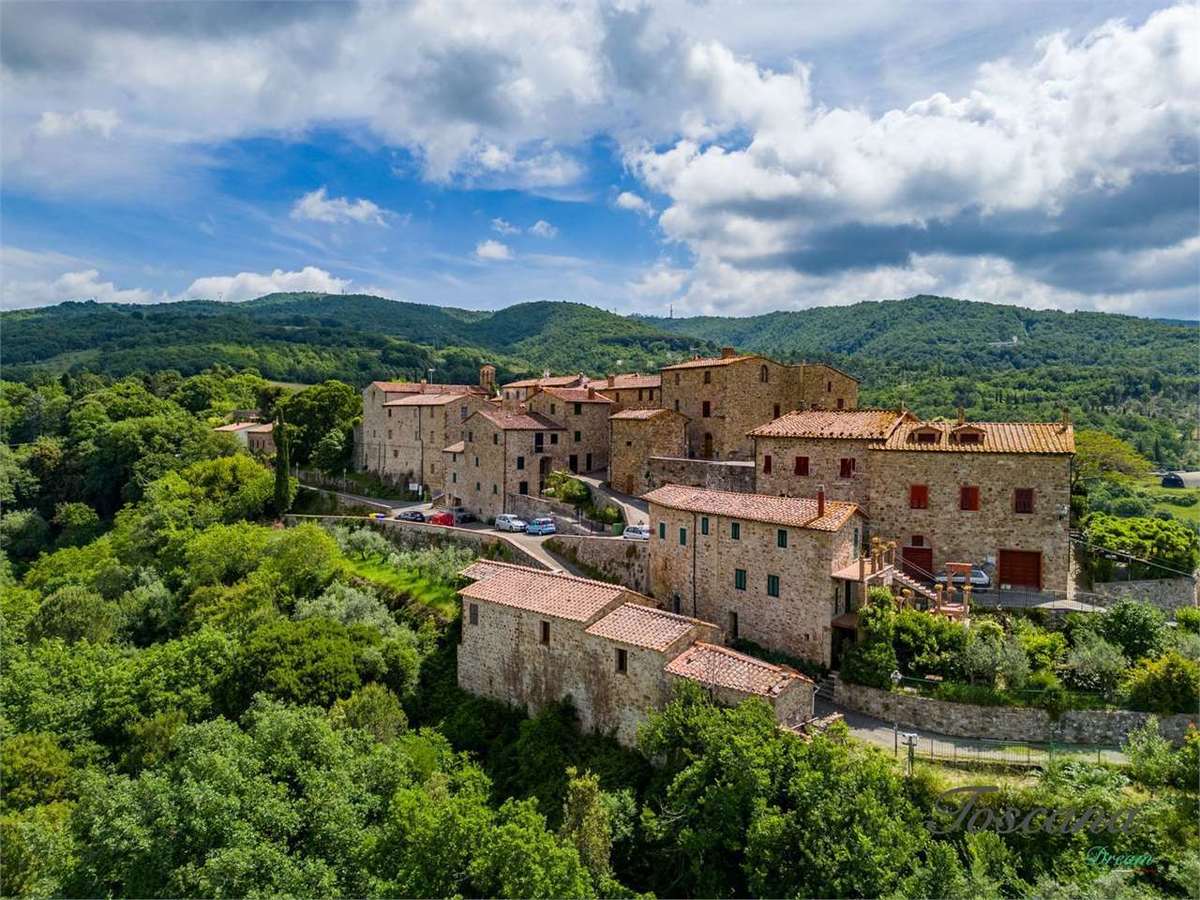
Featured: the €65,000 apartment inside a medieval castle
La Leccia, Castelnuovo di Val di Cecina, Pisa (Tuscany) — €65,000 (~$74,600), restored / habitable
Here we have a 72-square-meter apartment inside the medieval castle of La Leccia, in the hills of the Upper Maremma between Pisa and Siena, and you could move in this month. There is no renovation, no someday — which, as Wally points out further down, somehow makes it more daunting than the ruins. You would simply have to go live in a castle.
It's on two levels — living room, kitchenette, bathroom and bedroom downstairs, a double bedroom up — with exposed beams and a stone fireplace the listing calls, with no irony, rustic. It is. That's the whole point: the desirable thing here isn't potential, it's the eight centuries of stone still solid and standing and habitable – even comfortable.
The detail that lifts it above a cheap flat with a view lies beneath. The heating runs on geothermal energy, which the listing calls "the gold of the area" for its very low cost. This corner of Tuscany sits in the Valle del Diavolo, the Devil's Valley, where steam vents out of the ground at 130–160°C and where, at nearby Larderello, the world's first geothermal power plant was built in 1913. Living here means cheap heat drawn from the same furnace that scents the valley with sulphur and gave it its name. The hamlet of Sasso Pisano, a few steps away, has natural thermal pools; the village school, shop and butcher are within four kilometers; Pisa's airport is about 67 kilometers away. It's a 72-square-meter apartment, not a compound, and the nearest train station is a fair drive. You would live in your own small portion of a castle heated by the earth's core.
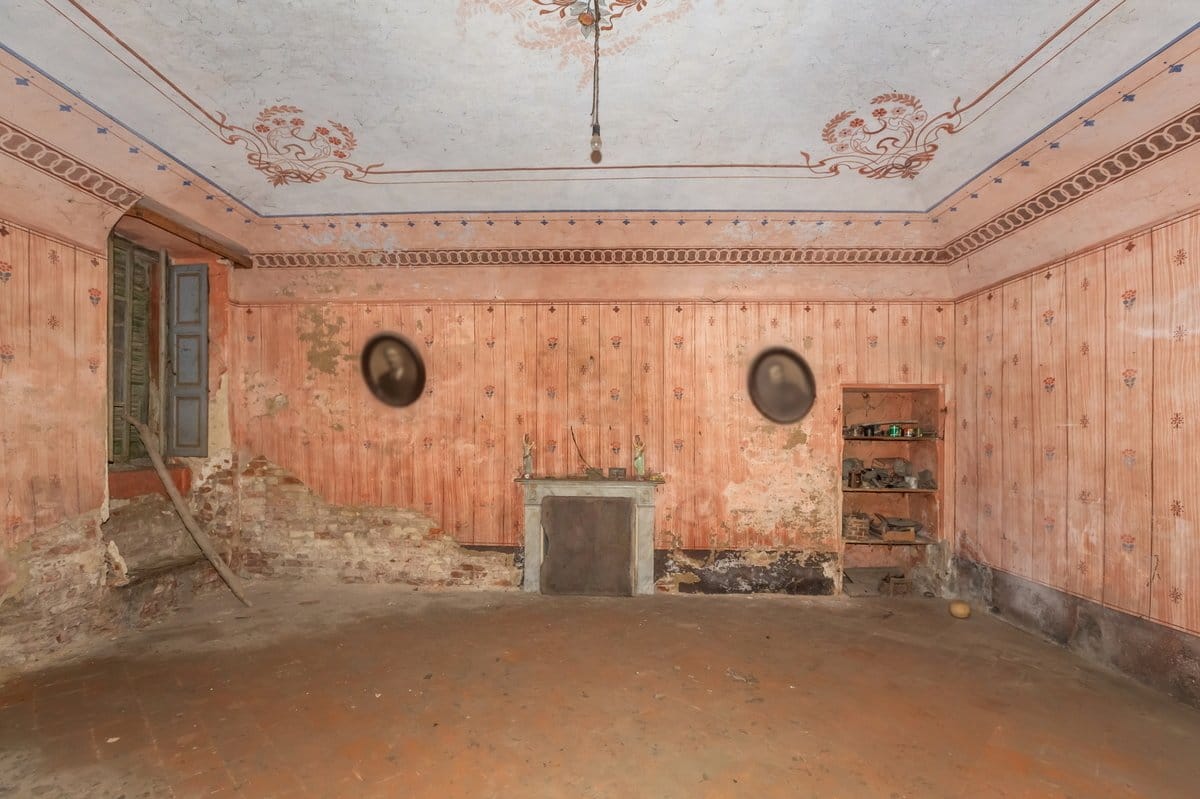
More: the €60,000 noble house with frescoes on the ceiling
Calliano, Asti (Monferrato), Piedmont — €60,000 (~$68,800), to be restored
If La Leccia is the move-in version, Calliano is the project — and the more improbable of the two listings. For sixty thousand euros this is a seventeenth-century noble house with frescoes still on its ceilings, in the historic center of a village of about 1,200 people in the Monferrato hills of southern Piedmont — wine country, all vineyards and ridgelines, part of the UNESCO-listed vineyard landscape that runs through the Langhe, Roero and Monferrato.
The house was built in the first decades of the 1600s, probably for a family of small local notables as the listing says, and it has the bones to prove it: 350 square meters over three floors, original plasters, floral and geometric frescoes, wooden ceilings carved in relief in two of the upstairs bedrooms. On the ground floor there's a large frescoed living room, a generous kitchen, two rooms that were once the sharecroppers' quarters, and an original stable with its stone feeders still in place. Up top, a fully recoverable attic under exposed beams. The roof was entirely redone in 2018 in the original style.
You are not buying a finished product; you are buying the decorative evidence of three hundred years of someone else's taste, and the structural soundness to restore it without starting from rubble. The listing is candid that it needs A LOT of work. But the things that make it desirable — the frescoes, the coffered ceilings, the noble proportions — are exactly the things you could never add back later. The question is, are those things worth it? 350 square meters is a lot of house to heat, fix and fill, and Calliano is a working village, not a resort. Turin's airport is about an hour away; the nearest train station, at Tonco-Alfiano, is three kilometers out. And the nearest ghostbusters outfit? You 'd have to look it up. Yikes.
Portugal
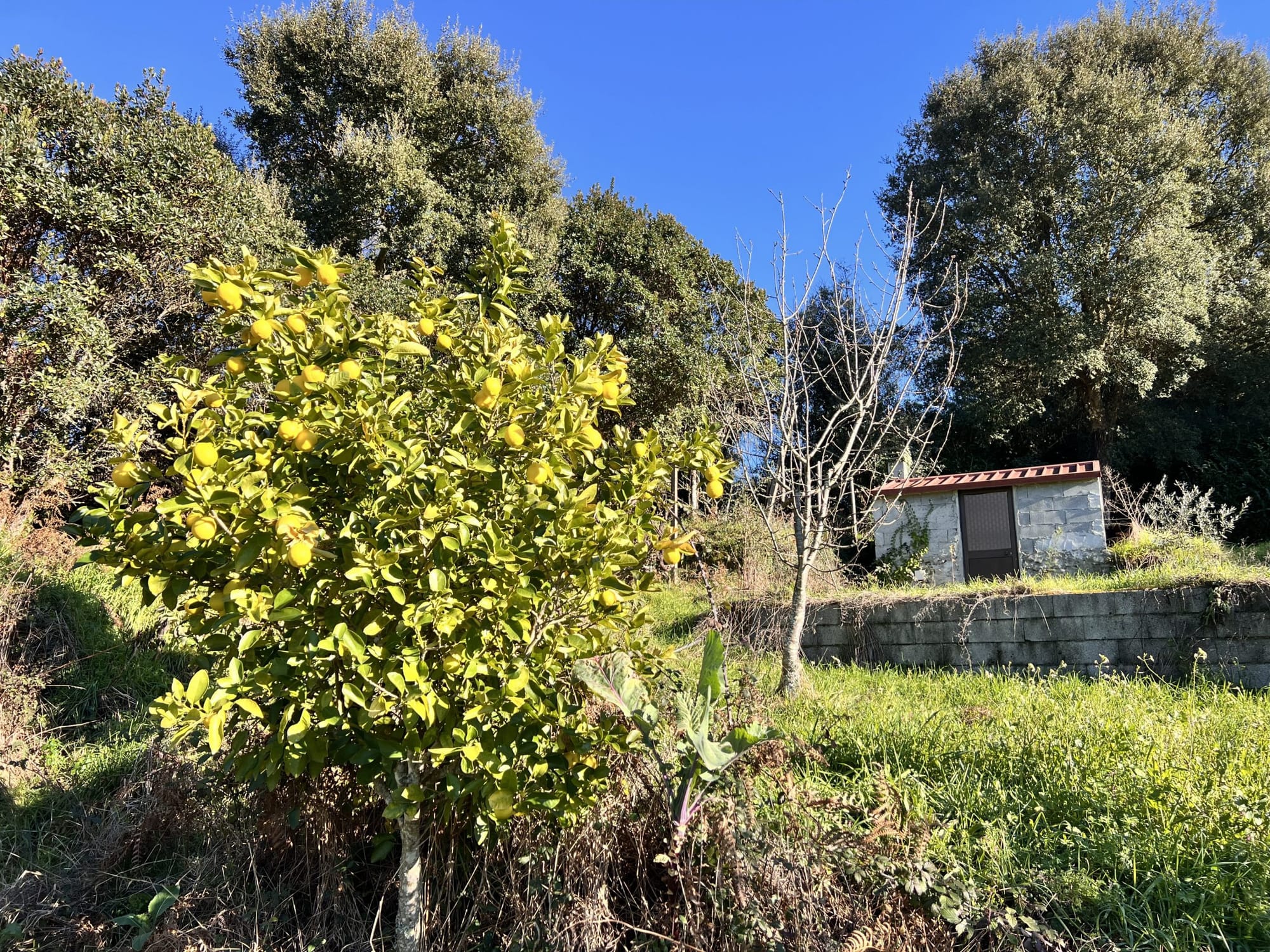
More: the €29,000 off-grid smallholding
Casal da Fonte, near Sertã, central Portugal — €29,000 (~$33,300), off-grid project
For twenty-nine thousand euros you get a small ruuuuustic with a capital R farmstead on the edge of a village in central Portugal: a two-storey natural-stone house with a 31-square-meter footprint, a roughly 10-square-meter stable, and a little cabin with a kitchen, all on 3,000 square meters of terraced land. The land is already working — olives, apples, pears and orange trees, fertile terraces, a well and a water tank in the forested section.
There is no mains electricity and no sewage. The well gives you water; everything else you build yourself, off-grid, with solar and a septic system as the recommended starting point. Sertã, the nearest town with real infrastructure, is about ten minutes by car. The coast is an hour; the Lisbon and Porto airports are roughly two. Annual property tax is around ten euros, which is not a typo. This is the version of the fantasy where the romance and the labor are the same thing — desirable precisely because nothing has been done to it yet. Also, this is fire country.
→ See the listing (Portugalissimo)
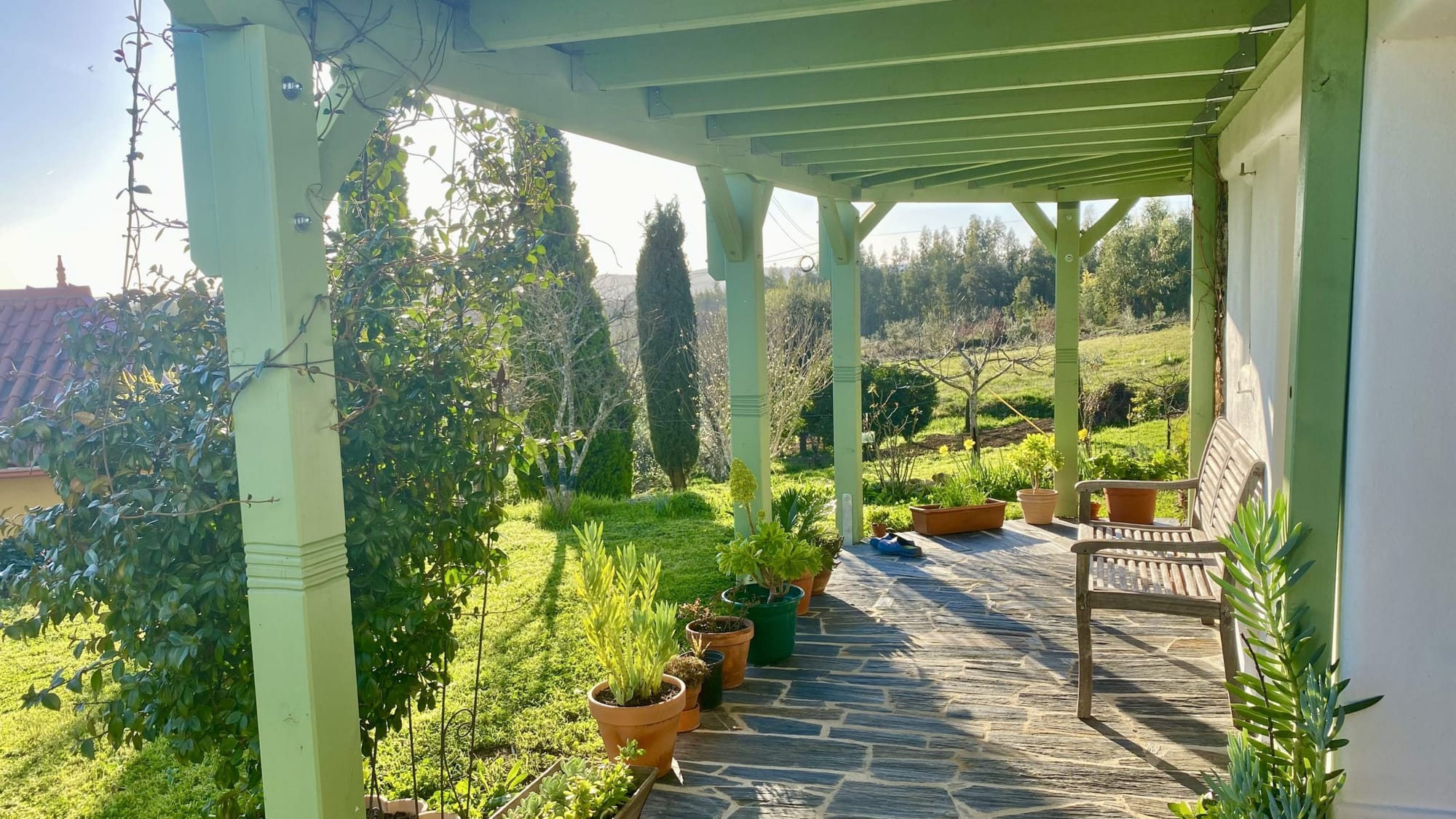
The splurge: the same dream, already finished
Vivenda da Marinha, near Pedrógão Grande, central Portugal — €289,000 (~$331,600), move-in ready
And here is where that same dream lands once somebody has already done the decade of work. Vivenda da Marinha is a 1950 stone house built on solid rock and renovated in 2016 to Central European standards — roof and floor insulation, the works — on an elevated, sunny plot with panoramic views, in the parish of Graça near Pedrógão Grande. It is fully furnished and ready to live in, and it comes with the things a finished rustic life accumulates: a separate renovated guest house, a paved courtyard, a workshop, a garage sized for a tractor, and a two-person wood sauna.
Across 1,900 square meters the land carries oranges, blood oranges, mandarins, lemons, limes, peaches, pomegranates, figs, plums, pears, cherries, strawberry trees, grapevines and passion fruit, on soil that's been cultivated for years. Water comes from both a well and the mains; there's an 800-watt solar system, a septic tank, and real internet options. At €289,000 it is roughly ten times the price of Casal da Fonte twenty minutes up the road, and the difference between them is the entire renovation — which is, in the end, the most useful price comparison this newsletter can offer. The off-grid stone house becomes this, if you have the years and the money. This is the bill for skipping that part. This is also fire country.
→ See the listing (Portugalissimo)
Japan
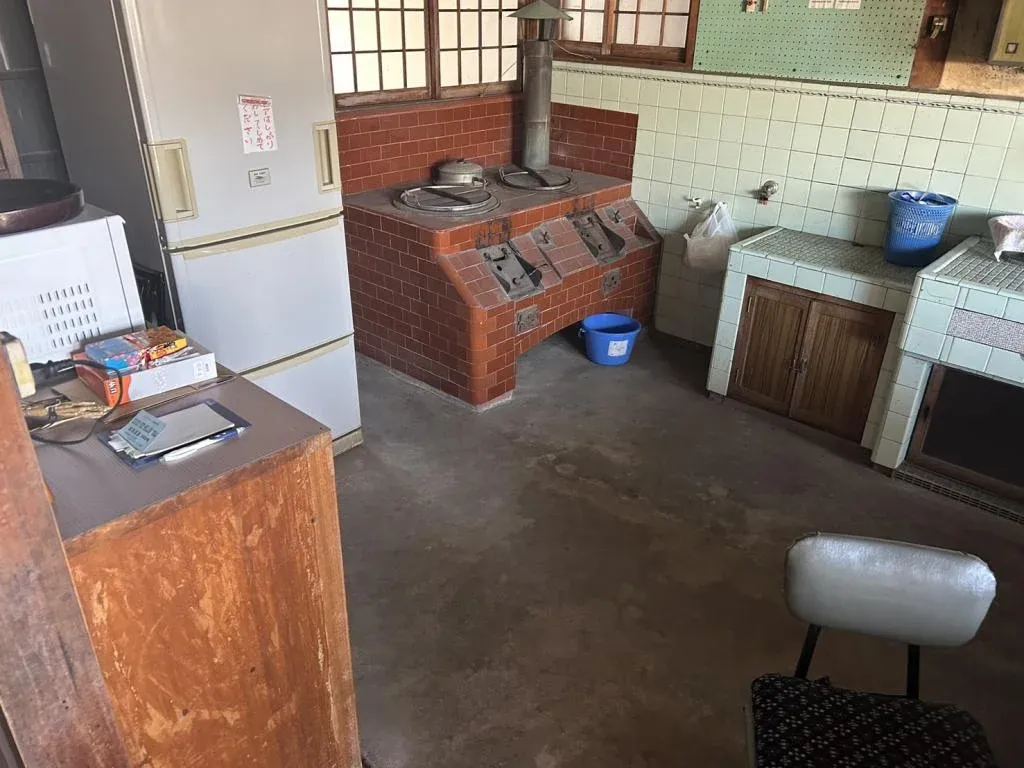
Featured: the 1927 farmhouse with a wood-fired kitchen stove
Katsuragi, Ito district, Wakayama (Kansai) — ¥19,800,000 (~$122,000), with farmland
The detail that makes this one is in the kitchen: a wood-fired stove, still standing in a house nearly a hundred years old. The house was built in 1927 (Shōwa 2) in the town of Katsuragi, in the Ito district of Wakayama, on the flat in the hills below Koyasan — the temple-monastery complex Kūkai founded in 816 as the center of Shingon Buddhism, the heart of a landscape so storied that several of its pilgrimage routes and shrines are UNESCO World Heritage. The town calls itself a "fruit kingdom"; its warm climate grows persimmons, peaches, grapes and pears around the year.
The house is substantial: 279 square meters of solid timber over two floors, a 6SLDK layout, on a 528-square-meter lot — and the sale bundles more than that, with an extra parcel of residential land and roughly 1,200 square meters of farmland (two fields) attached. There's a garden, parking for two, an elementary school a ten-minute walk away, a convenience store and post office within 550 meters, and Kaseda station on the JR Wakayama line six minutes off by car; a recent bypass cut the drive to Wakayama city to about half an hour. The listing is candid that it needs "some repairs" and offers a home-condition inspection. One line for the rustic-charm column: the toilet is still the old manual-collection type, not connected to a sewer. Plumbing, like the stove, is a period feature here. Whether the fluffy pink toilet seat cover is a pro or a con entirely depends on your taste.
Which brings us to the real complication, the one we flag in The Fine Print: that attached farmland. Japan tightened the rules on foreign farmland acquisition in April 2025, and buying agricultural land here runs through the local Agricultural Committee. At ¥19.8 million this is no one-yen ruin; it's priced like the substantial, restorable country house it is.
→ See the listing (Akiyahopper)
The Fine Print
A few things from our research this week, in case you want to keep going.
Can a foreigner actually buy these? Mostly yes, with the usual bureaucratic maneuvering. Italy lets American and most other non-EU citizens buy on the basis of reciprocity (the US permits Italians to buy, so Italy returns the favor); you'll need an Italian tax code (codice fiscale), a notary (notaio), and you should budget another 9–10% or so on a second home for taxes and fees on top of the price. Portugal has no nationality bar on buying property at all — you need a Portuguese tax number (NIF), a lawyer, and a notary. Japan places no restriction on foreigners owning houses or land in general, and you don't need residency or a visa to buy a building. The exception is the one that bites this week, below.
The Japanese farmland rule that can stop the Katsuragi sale cold. This is the most important paragraph in the issue. Buying agricultural land in Japan has long run through the local Agricultural Committee (nōgyō iinkai) under the Agricultural Land Act, which typically wants to see a genuine, often near-full-time, plan to farm the land — which in practice keeps out buyers without long-term residence, and certainly those on short-term or tourist status. In April 2025 Japan tightened things further, adding residency-status checks aimed specifically at foreign buyers of farmland. Some rural municipalities have lowered their minimum-area thresholds to move empty akiya along, so it varies place to place — but the Katsuragi sale bundles roughly 1,200 square meters of farmland (畑) with the house, which means the path likely runs through the committee, and possibly through residency you don't yet have. Before you get attached to any rural Japanese property, confirm the land classification (chimoku) and the committee's stance with the town hall. A beautiful 1927 farmhouse you are not permitted to buy is not a bargain.
"Off-grid" is a budget line, not a vibe. Casal da Fonte has a well and no mains electricity or sewage. That is genuinely workable — solar plus a septic system is a well-trodden path in interior Portugal — but price it thoroughly before the romance sets in: a solar array with batteries, an inverter, and a compliant septic install are real four- and five-figure costs, and they come before you've touched the house. The €29,000 sticker is the beginning of the number, not the end of it.
What happened to the American housing bill. The same week we were admiring everyone else's empty houses, the United States produced the most significant housing legislation in a generation — and then stalled it. The 21st Century ROAD to Housing Act, which contains the RESIDE Act from the top of this issue, passed the Senate 85–5 and the House 358–32: a bipartisan supermajority. On June 24, President Trump declined to sign it, saying that passage of the SAVE Act — a separate voting-eligibility bill — should come first. Because the housing bill cleared both chambers by well over two-thirds, Congress could override a veto; and under the Constitution, if the President neither signs nor vetoes within ten days while Congress is in session, it becomes law without him. So the bill is not dead. It's in limbo. We note it without taking a side: it's simply striking that a law to turn America's own empty buildings into homes is the thing left on hold.
Meanwhile, nearly everyone is doing some version of this at once. Read the week's headlines side by side and a pattern appears. In Ireland, the new chair of Mayo County Council urged the state to "throw the kitchen sink" at dereliction. In Spain, Asturias launched a pilot to untangle who actually owns its abandoned rural properties. East Cleveland residents want their local government to fix its vacant-house and squatter problem; West Virginia just put new money toward abandoned properties. Japan sent $160 million toward rural development abroad; Hong Kong is seeking $200 million for an urban–rural integration fund. And a Chinese national audit found that 56 counties had quietly diverted $3.9 billion in rural-development funds to pay down debt — the cautionary footnote to all of it, a reminder that money aimed at empty places does not always reach them.
One more time, because it matters: a deed is not a visa. Owning a house in Italy, Portugal or Japan does not give you the right to live there. Ownership and immigration are two separate systems, and the purchase answers only the first. Portugal's D7 (passive income) and D8 (digital nomad) visas are the usual long-stay routes, and note that the Golden Visa's real-estate path was closed back in 2023 and isn't coming back — it was never the cheap-house route anyway. We are an information aggregator, not a relocation service; when we cover a country in depth we round up the visa pathways so you can see them in one place, but the immigration question is its own piece of work.
Lifestyle & Culture Notes
What "Rustic" Feels Like on a Tuesday
The fantasy is a frescoed ceiling and a fireplace. The Tuesday is heat, water, and distance from amenities — the three things every house in this issue is really a referendum on.
Heat first, because it's where rustic stops being a mood and becomes a bill. The Tuscan castle flat at La Leccia is the lucky one: geothermal warmth pulled from the Devil's Valley for almost nothing, the rare case where the romantic detail and the utility bill point the same way. The Piedmont noble house is the scary one: 350 square meters of seventeenth-century stone holds cold like a cellar, and heating all of it through a Monferrato winter is a project in itself — which is why people who restore houses like that often live in three rooms of them and close the rest off until spring. The Portuguese stone houses split the difference: thick walls that stay cool through the long dry summer and ask for a wood stove from December to February.
Then water and waste, the parts no one daydreams about. At Casal da Fonte you are your own utility company: the well is your tap, the septic tank is your sewer, the solar panels are your grid, and a cloudy week is something you actually plan around. At Vivenda da Marinha, someone already solved all of that — well plus mains, septic, solar, real internet — and the €260,000 gap between the two houses is, almost exactly, the price of never having to think about it.
And distance. None of these villages is remote in the cinematic sense, but all of them reorganize a week around the car. Ten minutes to Sertã for groceries. Three kilometers to the train in Calliano. A ten-minute walk to the school below Koyasan. The rustic life isn't isolation; it's the constant calcualtion of how far? February is the test. If a place is still good to you in February, when the tourists are gone and the heating is (hopefully) on and the nearest anything is a drive, it was never really just about the view.
Recipes from the Map
Two rustic dishes that are, at heart, survival food made beautiful — which is the whole theme of the issue, on a plate.
From the Tuscan hills around our castle flat, acquacotta Maremmana— literally "cooked water," the Maremma's peasant soup. It began as exactly what its name says: stale bread softened in a broth of onions, tomato and whatever wild greens the day offered, with an egg slipped in to poach on top at the end. The edible version of making something desirable out of what is at hand.
From central Portugal, chanfana — kid or goat slow-braised in red wine in a black clay pot until it falls apart, a Beira classic born of using the tougher, older animal and giving it hours in the oven.
What we're reading
Seven things from our tabs this week, most of them circling the same global question.
- The new chair of Mayo County Council wants the state to "throw the kitchen sink" at dereliction, via the Irish Independent. Ireland's vacant-house fight, from the desk of someone who just made it his priority.
- Asturias launches a pilot to clarify who owns its abandoned rural properties, via Demócrata. The least glamorous and most important step of all — you cannot revive a house until you can find out whose it is.
- Trump upends the bipartisan housing bill, leaving lawmakers scrambling, via NPR. The fullest account of how the 21st Century ROAD to Housing Act — RESIDE Act included — passed and then stalled.
- What to know about the Kushner-backed luxury resort drawing protests in Albania, via TIME. The shadow version of this whole newsletter, at $4 billion and a frozen-asset investigation.
- The Debate: can Albania push back against the Trump family?, via France 24. The protests on video — the "Flamingo Revolution," a leaderless movement in a country of 2.4 million taking on a US president's family over a resort on protected Adriatic coastline.
- East Cleveland looks for a solution to its vacant-house problem, via WAFF. The American version playing out on this particular block.
- China's audit finds 56 counties diverted $3.9 billion in rural funds to repay debt, via Vision Times. The cautionary footnote: money sent to refill empty places doesn't always arrive.
Live from our group chat
This is the part where we let you eavesdrop on the week's rabbit hole.
Malia: There is an apartment inside a medieval castle in Tuscany for sixty-five thousand euros and it is heated by a volcano. I have read this sentence twelve times and it has not stopped being true.
Wally: It's geothermal, not a volcano, and it's already livable, which somehow makes it more alarming than the ruins. No years of renovation to hide behind.
Malia: Meanwhile the 1927 farmhouse near Koyasan — the one with the wood-fired stove still in the kitchen — is the one I actually want, and apparently I'm not legally allowed to buy the land its on.
Wally: Right — farmland, post-April-2025 rules, the agricultural committee wants a farmer, not a daydreamer. We'd have the frescoes in Piedmont and the castle in Tuscany before we'd have that field. From which, for the record, I'd take the second. Fine, twist my arm, I'll live in a castle.
That is issue seven. Thanks for reading.
Until next week, Wally & Malia
Remnant is a weekly newsletter about distressed and beautiful houses around the world. We are not real estate agents. We just got a little obsessed and started digging. What will you do with what we find?