
Remnant – Issue No. 8


Four stone houses on Spain's pilgrim routes from €93,000 — a medieval house in Mondoñedo, a restored complex where the Camino passes by the front door, and more.
Last year, the official count from the cathedral’s Pilgrim’s Office of people who walked the Camino into the city of Santiago de Compostela was 530,919 – a record number. Meanwhile, the countryside these pilgrims traversed (like so many rural areas around the world) is weathering ongoing population decline.
Spain has a name for this: España Vaciada, Emptied Spain. During the second half of the twentieth century the country lost roughly 40 percent of its rural population to the cities, and between 2010 and 2019 more than three-quarters of Spain’s municipalities kept shrinking. Monocle, a UK global affairs and culture publication, traveled 2,000 kilometers across this landscape a few years back in 2022, reporting on the counter-movement: plastering workshops in Aragón, an olive-tree sponsorship program that that took the village school from four students to fourteen, a hamlet in Castilla y León that went from one elderly couple to fifty people because somebody started a preschool. The piece is a few years old now and still holds up (it’s linked in the reading list).
Monocle’s road trip ends in Galicia, at the desk of a Brit named Mark Adkinson, who keeps a map with 3,500 pins on it, one for every empty village and abandoned estate he has catalogued, and who told the magazine he was selling 18 to 20 of them a month to people willing to take on a restoration. His website is called Grupo Country Homes. All four houses in this issue are from their catalog. (For the record, there is no affiliation, we just like their listings).
So this week is Spain, specifically the wet green corner of it, and specifically four houses that sit on the pilgrim roads — three different routes: the Camino del Norte, the Winter Camino that medieval walkers used to dodge the snows of O Cebreiro, and a route following a Roman road out of Portugal.
The houses below run from €93,000 to €219,000. The least expensive one is already semi-restored; the €99,000 one needs everything but the roof. We use the word ‘cheap’ fairly often in this newsletter. The question is always: Cheap to whom? Compared to what? Is a fixer-upper ever really cheaper than the finished thing? We don’t have a formula. We’re writing from Los Angeles. Please adjust your definition of the word accordingly.
This week: two featured houses (a restored complex where the Camino passes the front door, and a semi-restored medieval house in a cathedral town), two projects for the brave and prosperous, the practical details on buying in Spain, an open letter to the half million people who walked past the featured house last year, two recipes, the reading list, and our silly group chat.
Galicia, Spain
Featured: a house on the Camino
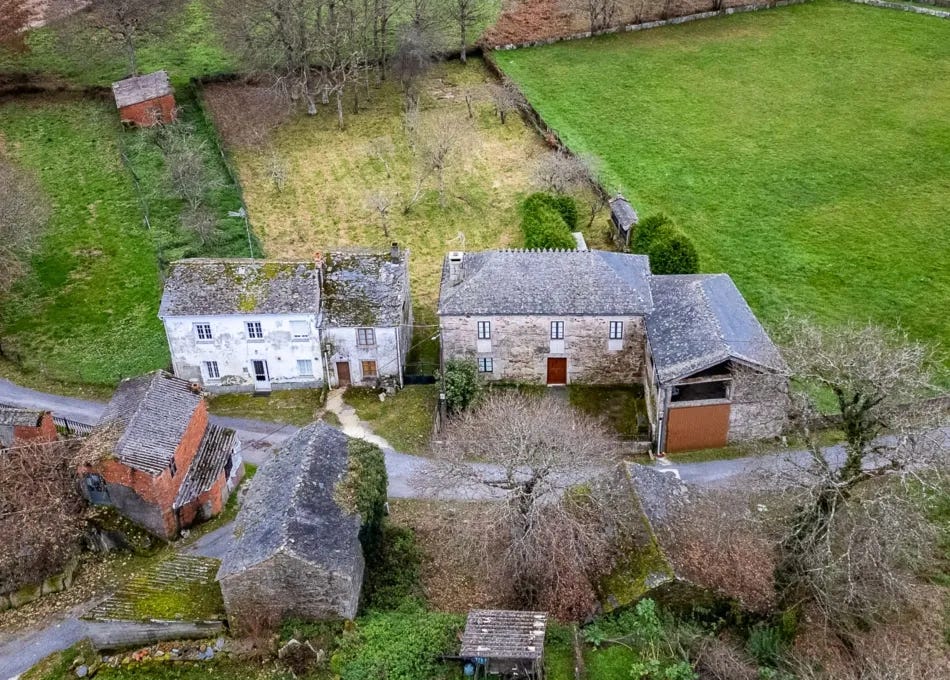
Guitiriz (Parga), Lugo — €219,000 (~$250,000), main house restored and furnished
This property includes a complex of four buildings on 1,880 square meters of flat land in Terra Chá, the great Galician plain. The Camino del Norte passes right in front of it. The stone marker is in the listing photos. Pilgrims who left the coast at Ribadeo and are three or four days from Santiago walk past this house every single morning of the season.
The main house is two-story stone, completely restored and furnished, with the traditional lareira (open Galician hearth), an original stone sink, exposed beams, slate floors, three bedrooms up top and a little sitting room with a bookcase. The village has its own pilgrim hostel, and 200 meters away there is a river recreation area where you can swim in summer. The other three buildings make up the rest of this compound: a second house to restore on the back plot, a garage across the way, and a double-height open barn with a traditional wood-fired bread oven and, per the listing, room to build a two-story house or apartments inside it. There is also a hórreo, and a large stone table under the fruit trees.
Terra Chá sits inside the UNESCO Terras do Miño biosphere reserve, Lugo is 40 kilometers away, A Coruña 65, Santiago itself 80. Note: several hundred thousand people a year will walk past your gate, footsore and fancy free, which is either the best or the strangest amenity we have ever listed.
Featured: a €93,000 medieval house in a cathedral town
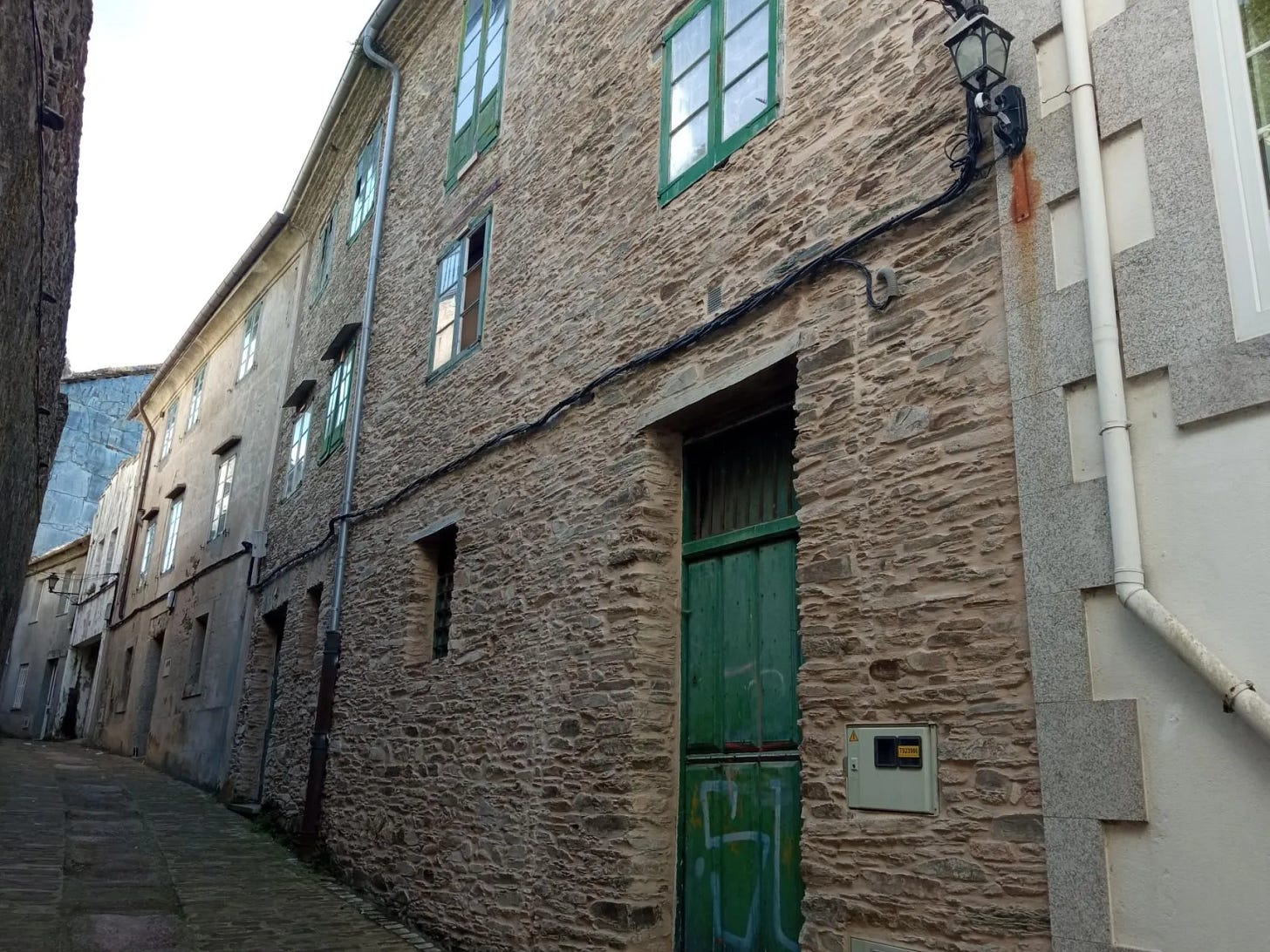
Mondoñedo, Lugo — €93,000 (~$106,000), semi-restored
The value option this week is a house from 1800 with medieval arches inside it, at number 19 on a cobbled street in the historic center of Mondoñedo, one of the seven historic capitals of the old Kingdom of Galicia. The whole town center has been a protected Historic-Artistic Complex since 1985, and the Cathedral-Basilica of the Assumption is a few minutes’ walk from the front door. The Camino del Norte runs through town; pilgrims coming down from Lourenzá pass through on their way up to Abadín.
The roof is new, on laminated fir beams, and the interior has been opened into clean, open-plan floors, roughly 140 square meters each across two stories, plus another 60 under the roof. The original semicircular stone arches have been protected behind glazing rather than plastered over, and a wooden glazed gallery at the back connects the house to a garden space. What remains is the finishes: rooms, kitchen, bathrooms, the layout of an actual life, which means you could make it what you want. The listing calls it “ideal to finish reform.”
Mondoñedo sits in the Mariña Lucense, the green coastal strip of Lugo province, which means Praia das Catedrais — Cathedral Beach, the one with the rock arches that people cross Spain to photograph — is twenty minutes away. Santiago’s airport is 80 kilometers. For a semi-finished house in a UNESCO-adjacent town center, $106,000 is about a tenth of the median house in Los Angeles, and it comes with cathedral bells.
More: a €99,000 estate with a two-hour irrigation allocation
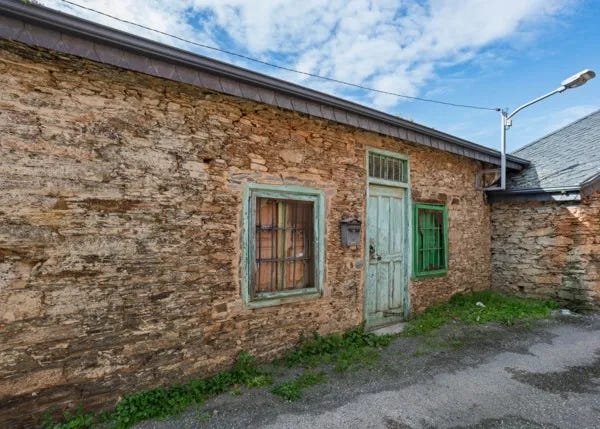
A Rúa (Valdeorras), Ourense — €99,000 (~$113,000), to restore
This one is for readers who saw the word ‘project’ in previous issues and thought, not hard enough. It is a large L-shaped single-story stone house, 466 square meters built, with old stables and a wine cellar underneath, on 3,375 square meters of buildable land enclosed by a stone wall, one kilometer from the town of A Rúa in the Valdeorras wine region. The roof — slate, the expensive part — has been completely restored. The interior needs everything else. There is a well, a connection to electricity and public sewerage, an outbuilding with a stone-and-slate roof, and our favorite line item in the issue: a daily irrigation allocation of two hours.
For reference: this costs six thousand euros more than the semi-restored Mondoñedo house above.
The Winter Camino passes less than a kilometer away. This is the route medieval pilgrims took to avoid the snows of O Cebreiro, 263 kilometers from Ponferrada to Santiago along the Sil river valley, used by Roman legions and muleteers before the pilgrims got to it, and now the least crowded of the major routes. Valdeorras itself is a Denomination of Origin wine region, godello whites and mencía reds grown on mountainsides, with Roman bridges left lying around the way other regions leave old gas stations. A Rúa has a town center, and Ourense, 95 kilometers off, has a rail station with direct connections across Spain.
More: the €115,000 farmstead 35 km from Santiago itself
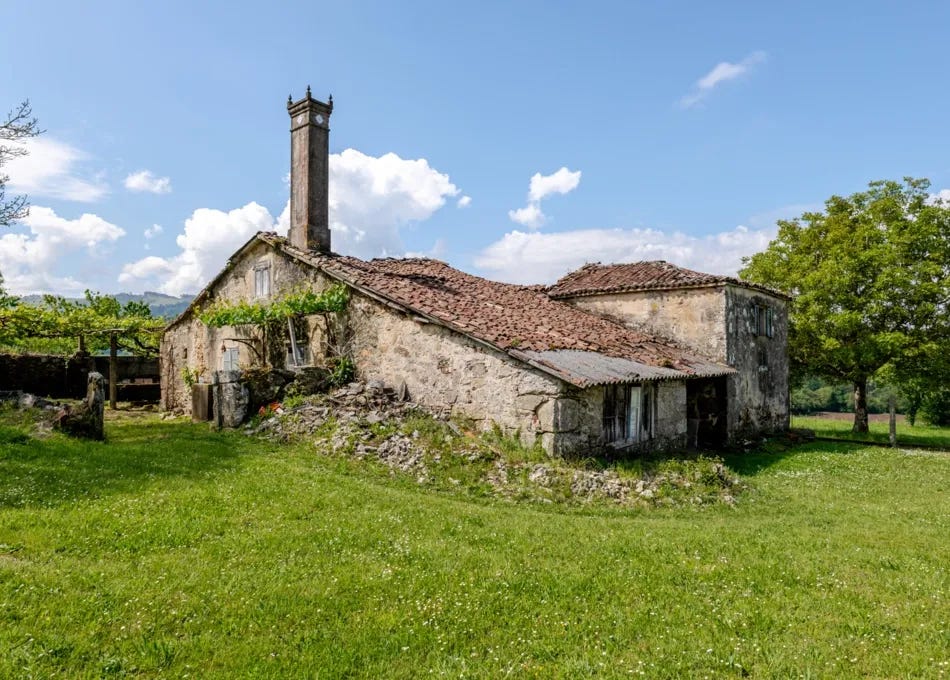
A Estrada (Rubín), Pontevedra — €115,000 (~$132,000), to renovate
Here we have a stone farmstead not too far from the Camino finish line on 5,017 square meters of completely flat land in the parish of Rubín, 35 kilometers from Santiago de Compostela, with the Camiño da Geira e dos Arrieiros running 300 meters from the gate. That route follows an ancient Roman road 240 kilometers up from Braga in Portugal, and the cathedral chapter only officially recognized it as a Jacobean route in 2019, which makes it the newest old road in this issue.
The main house is two stories of solid stone masonry crowned by a carved stone chimney, but the roof needs full replacement and the upper floor needs full structural renovation. What you get for taking that on is a compound. There is an attached brick building with a wooden staircase with turned balusters, the remains of a third stone outbuilding, a good-sized hórreo with cross and pinnacle finials, a built-in wood-burning oven and an old cast-iron stove in the kitchen, two independent access points, and a mature grapevine trained over a metal frame making a shaded room outdoors. A Estrada, twelve minutes off, is known for nineteen Romanesque churches and the Rapa das Bestas, the annual wild-horse roundup in Sabucedo. Santiago’s international airport is 33 kilometers. One note from the fine print of the listing: the white prefab building next to the granary is not included in the sale. If it was LA, that would be code for: your landlord (or in this case former owner) will be living at least part time in the ADU in your back yard.
The Fine Print
A few things from our research this week, in case you want to keep going.
Can a foreigner buy these? Yes, with paperwork. Spain places no nationality bar on buying property. What you need is an NIE (Número de Identidad de Extranjero, the foreigner ID number that unlocks nearly every transaction in Spain), a Spanish bank account in practice, and a notary for the deed. Budget roughly 10 percent on top of the purchase price for the transfer tax and fees on a resale home in Galicia. The tax rate is set regionally and moves around, so have a lawyer confirm the current number before you sign anything.
About that “100 percent tax on foreigners” headline you may have seen. In January 2025 Spain’s prime minister floated a dramatically higher tax on home purchases by non-EU non-residents, and the internet did what the internet does. As of this writing it remains a proposal, not law; a draft went to parliament in 2025, plenty of parties oppose it, and the government does not hold a majority. Worth watching if you are American and serious about Spain. Separately and definitively: Spain’s golden visa ended in April 2025. A house in Spain has not been a residence permit for over a year now, and a deed is still not a visa. The usual long-stay routes are the non-lucrative visa (passive income) and the digital nomad visa.
The pilgrim economy is real infrastructure. The Pilgrim’s Office issued 530,919 Compostelas in 2025, up six percent on the year before and nearly double a decade ago; about a third of all walkers start in the town of Sarria, 100-odd kilometers from Santiago, and the routes these four houses sit on all feed the same cathedral square. For the villages along the way this is a conveyor belt of people who need beds, dinners, coffee, and blister plasters, twelve months a year on the busy routes.
Similar issues, different approaches to solving them. American towns will now pay you up to $20,000 to move there — West Virginia’s remote-worker program, Topeka’s $15,000, a spread of Indiana towns up to $20,000 — which is to say, one-fifth of the Mondoñedo house. Rhondda Cynon Taf in Wales has spent nine years and millions in grants and loans pulling 725 long-empty homes back into use, and Spain has Vente a Vivir a un Pueblo, a platform where villages pay to be listed to attract residents, with housing, jobs, and business-transfer boards.
Lifestyle & Culture Notes
An Open Letter to the 530,919 People Who Walked Past My House Last Year
The lead piece of this section now tries a different format every week. This week: a letter from the imagined future occupant of the Guitiriz house.
Dear pilgrims,
Good morning. I say it collectively, because you arrive collectively. I knew what I was signing. The stone route-marker stands at my gate. I did not buy privacy; I bought a continuous parade of avid walkers with no end date.
Some housekeeping notes, since we live together now.
The hórreo is not a tiny church. It is a granary on granite legs, it is probably older than your home country, and you may not sleep in it. The hostel is in the village. The river is 200 meters ahead and swimmable in summer, and I recommend it over the fountain, which has served walkers since the Middle Ages, but no longer emits much water.
I am not an official stamp station. The rubber stamp I keep by the door is an image of a hedgehog, purchased at a stationary shop in Lugo, and it has no canonical standing. Forty-one of you have it in your credentials anyway. Do carry that hedgehog to the cathedral, with my blessing.
Yes, it is raining. Technically it is called orballo, the Galician drizzle that hovers rather than falls, and it’s the reason everything here is green in August while the rest of Iberia goes brown. It is also the reason my north wall is a moss farm. I have made peace with the wall. You have 80 kilometers left; I suggest you do the same with your socks.
A word on seasons, from my side of the window. From May through September you pass in the hundreds, and I resent you before my first cup of coffee and wave at you after my first aperitivo. From November through February you thin to the devout and the unhinged, and I mean this respectfully: February walkers, you are my favorites. You are also, statistically, three or four days from Santiago. The cathedral has stood since 1211. You have time to sit down.
The dog (my dog) is not lost; he works here. The laundry on the line is not folk art, and the couple who photographed it in April should know that undies also must be hung out to dry. And to the woman who left a bag of chestnuts on the stone table in October: that is the correct use of the stone table, and I remember you kindly.
Buen camino. The kettle is on, but the answer to “is this a café” is still no.
— The occupant
P.S. If you weren’t just passing through, would you thrive here or absolutely lose your mind? I ask myself this most mornings.
Recipes from the Map
Two Galician standards for people who just walked 25 kilometers in the rain.
Caldo gallego via La Tienda — the region’s pot of greens, white beans, potatoes and pork. It’s the meal what the albergues serve pilgrims in winter, and the correct thing to be simmering while your roof is being replaced.
Tarta de Santiago via The Spanish Chef — the almond cake of the pilgrimage itself, dense with ground almonds and dusted with powdered sugar around a stencil of the cross of Saint James. Bakeries in Mondoñedo and every town on the routes sell it.
What we’re reading
- Back to the land, via Monocle. Plastering workshops in Used, sponsored olive trees in Oliete, a repopulated hamlet in Soria province, and the Galician agency where we sourced this week’s listings. Published in 2022, but the movement it documents has continued to grow.
- 6 U.S. cities that will pay you to move there in 2026, via Forbes. The American version of revitalization efforts: $10,000 to $20,000 in cash and perks for remote workers willing to relocate.
- Bringing long-term empty homes back into use in the Rhondda, via WalesOnline. Nine years of council-tax premiums, loans and grants in one Welsh county borough: empties down 869, and 725 homes actually reoccupied.
- Nigeria moves to document millions in assets abandoned by citizens fleeing South Africa, via Business Insider Africa, and South Africa rejects Nigeria’s compensation demand, via Vanguard. These two stories are about property abandoned due to social and political threat within a matter of weeks. Anti-immigrant groups in South Africa set June 30 as an unofficial deadline for undocumented foreigners to leave, and thousands fled ahead of it, many Nigerians among them. Nigeria’s government is now documenting the businesses and properties its citizens left behind, in hopes of seeking compensation; South Africa has refused, answering that anyone with legally registered property is free to sell it on the open market.
Live from our group chat
The part where we let you eavesdrop on the week’s rabbit hole.
Malia: The Guitiriz listing says the pilgrims passing your door enrich the area with their “cultural dynamism.” I have already planned my tortilla de patatas stand. Day one, free slice and a stamp for the credential. I am going to be a rumor on the Camino forums by August.
Wally: You do not have a credential stamp.
Malia: I’ll commission one. A little hórreo on stone legs. Meanwhile you have been staring at the A Rúa spec sheet for two days.
Wally: Because it says “daily irrigation allocation of two hours” and I need to know everything – Who keeps the schedule, whether there is a ledger, and can I can trade slots with a neighbor like it’s 1450...
Malia: So we agree. You take the water rights, I take the tortilla stand, and we get our mail forwarded to number 19, the cobbled street, Mondoñedo.
That is issue eight. Thanks for reading.
Until next week, Wally & Malia
Remnant is a weekly newsletter about distressed and beautiful houses around the world. We are not real estate agents. We just got a little obsessed and started digging. What will you do with what we find?