
Remnant – Issue No. 9

A ¥2.9M farmhouse in Japan's emptiest prefecture, a live €1 house program in Rubia Daniels's Sicilian town, a hideout behind the Cinque Terre, and an alpine province that will grant you up to €100,000 to rebuild a mountain house.
Two articles crossed our desk this week, seven days apart, and they land on opposite sides of one question: when a place is depopulating, do you save it or focus resources elsewhere?
The first article is a policy essay out of Japan. Japan has roughly nine million empty houses now, about one for every fourteen people. The writer's position is that the country is past the point of saving every village, and should stop trying. The word used is triage: fund a handful of anchor towns properly, give the fragile places a floor of basic services, and let the rest wind down with dignity instead of dribbling money across a map that keeps losing folks.
The second is about a woman named Rubia Daniels. She's Brazilian, living in California like us, and in 2019 she bought a house in Mussomeli, Sicily, for one euro, then she bought more in the same town. One was in such a state that part of the roof had come down into the kitchen. She flew tools over from the States, hired local masons, and hauled out fifty small trucks of debris. Idealista revisited her this year as a kind of patron saint of the whole one-euro movement, which is why she's back in the news.
So there's the whole issue in two people who will never meet: an economist with a spreadsheet saying some of these places should be allowed to die, and a woman with a dumpster saying not this one. This week we are not going to settle it, but we're going to show you four houses that together begin to illustrate a spectrum, from the emptiest prefecture in Japan to a province in the Dolomites that will grant a newcomer up to €100,000 to rebuild.
This week: one real Japanese farmhouse in Tottori, three Italian one-euro programs arranged from "bid on it Tuesday" to "apply and be vetted," the Fine Print on Japan's bear problem and some practical notes about these programs, two recipes, the reading list, and our silly group chat.
Japan
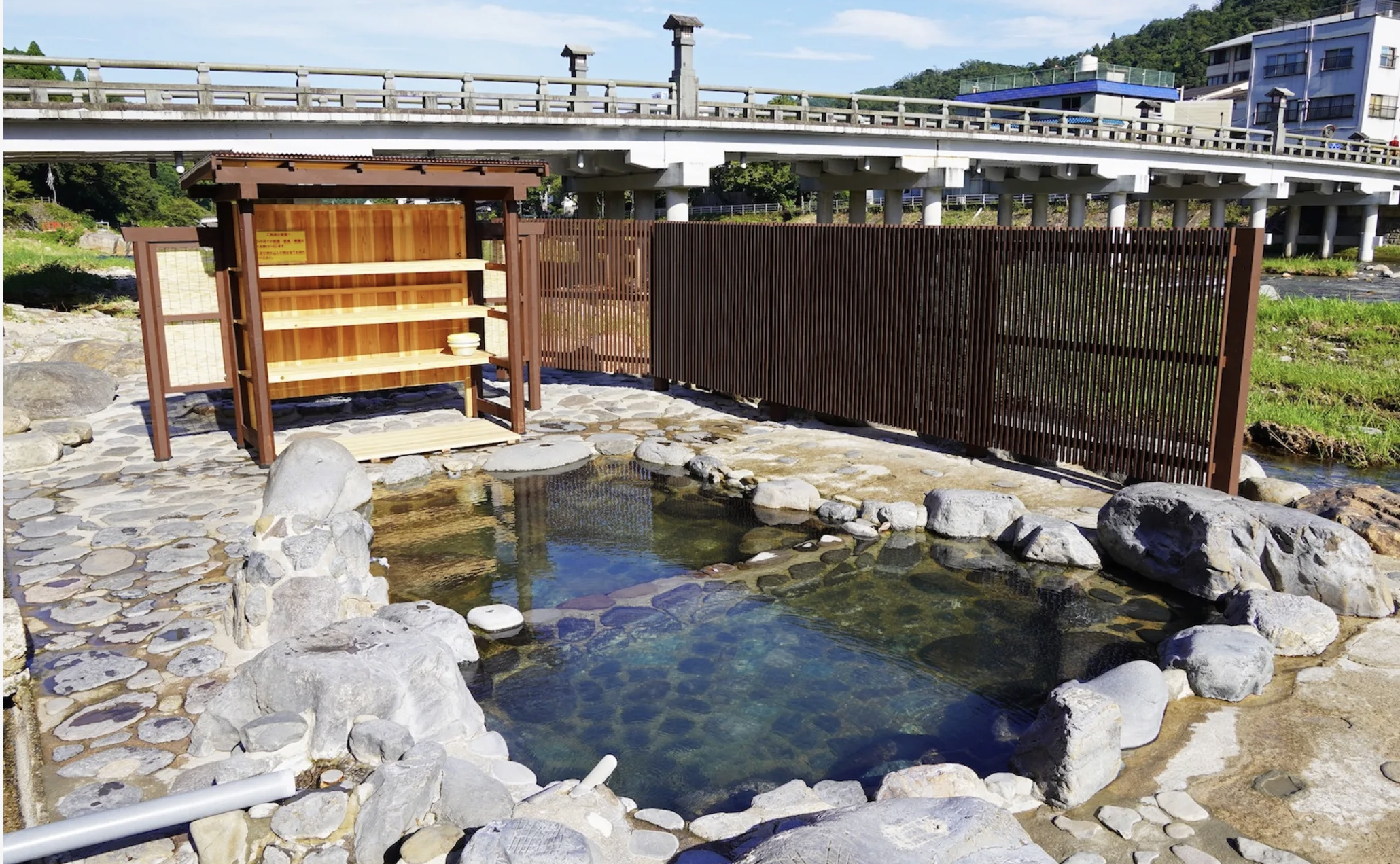
Featured: a farmhouse in the emptiest prefecture
Tsuga, Misasa Town, Tottori — ¥2,900,000 (~$19,000), traditional kominka
We are starting at the micro end, with one actual house and no program attached. A traditional kominka (that's an old timber farmhouse) in the Tsuga area of Misasa, a mountain town in Tottori, was recently listed on the town's akiya bank at 2.9 million yen, which is about nineteen thousand dollars. Roughly 290 square meters of floor space sat on 836 square meters of land, for a house the size of a small inn. By the time we went to link it, it had already been taken, which is its own lesson: the good ones on an akiya bank in the emptiest prefecture in Japan move fast, so the way in is to watch the bank and register with the town rather than fall for a single listing.
Tottori is the least-populous of Japan's forty-seven prefectures, which is the entire reason a house this size costs so little. It's also the point of this issue. The Japan essay we keep mentioning would look at Tottori's mountain hamlets and start sorting them into keep, maintain, and let go. Misasa itself lands on the sturdier end of that sort, because it has something most emptying villages don't: Misasa Onsen, a hot-spring town famous for its radon-rich waters, which have drawn bathers for something like eight centuries.
The price is the down payment on what will surely prove to be an adventure. A house built before 1950 in the traditional method is beautiful and cold, and the renovation will run some exponential multiple of the purchase price. Akiya banks also generally want to see you actually move to the town, and most will not sell to someone still living overseas, so this is a "we're serious about relocating" house, not a "we'd like a summer place" house. More on that mechanism in the Fine Print.
One more thing, which we file under both charming and cautionary: this is bear country. The mountains of western Japan are where the black bears live, and as you'll read below, the countryside emptying out is exactly what's been bringing them down toward the houses. Buy the farmhouse, meet the (wild) neighbors.
→ Browse the Misasa akiya bank
Italy
Three currently-open programs in Italian villages. We've put them in order from one that lands you with a serious project (you bring the money) to one that gives you money to purchase and renovate.
A town you can buy into right now
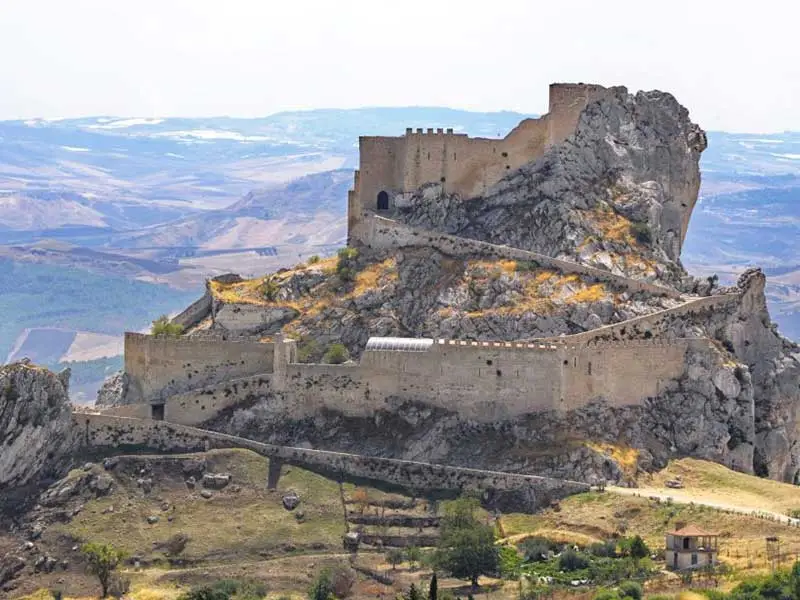
Mussomeli, Caltanissetta, Sicily — €1, roughly 450 sold and still going
If the name rings a bell, it's because we opened with it: Mussomeli is where Rubia Daniels bought her €1 house. It's the most active one-euro program in Italy, a working pipeline. Around 450 houses have sold to buyers from eighteen countries, the town keeps multilingual agencies on hand to walk foreigners through the paperwork, and the platform is permanent instead of a one-time auction. The mechanism is the standard one: the price is symbolic, you post a €5,000 refundable deposit, you start work within a year and finish within three, and realistic renovation budgets run €20,000 to €35,000.
Mussomeli sits in the hills of central Sicily under a dramatic clifftop castle. The €1 experiment has thrown off effects the town never planned for. Among the new arrivals were ten Argentine doctors, whose presence helped keep the local hospital unit open when it was at risk of closing, and annual visitors have climbed from a few hundred a decade ago to more than eight thousand.
This is the buy-it-now end of the issue. The listings are real, the deposit comes back, and there are English speakers on the ground to show you the actual houses.
→ See Mussomeli's €1 houses program
A back door to Cinque Terre
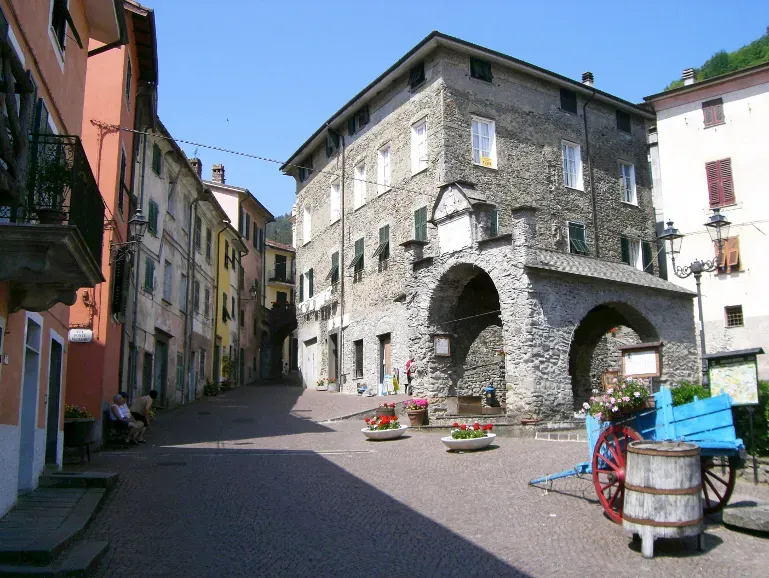
Pignone, La Spezia, Liguria — €1 base, program open
Everyone has seen the Cinque Terre, the five painted fishing villages stacked over the Ligurian Sea, photographed more than almost anywhere in Italy. Almost nobody has heard of Pignone, which sits just inland behind them with around 550 residents and a stack of empty houses it would like to fill. That's the whole pitch: one-euro prices a twenty-five-minute drive from the most expensive coastline in the country.
Pignone is the green, quiet version of its famous neighbors. You enter the old center over a donkey-backed Romanesque bridge built around 1500. The valley grows its own potatoes, beans, and a "dry" corn that becomes the local polenta, celebrated every late summer at a market fair called the Gardens of Pignone. The surety here scales with the size of the job: €5,000 if your works come in under €50,000, €10,000 if they run higher. It's the coastal-adjacent option for someone who wants the Ligurian light and the hiking trails without the Ligurian price tag or the summer crowds.
The one that grants you the money
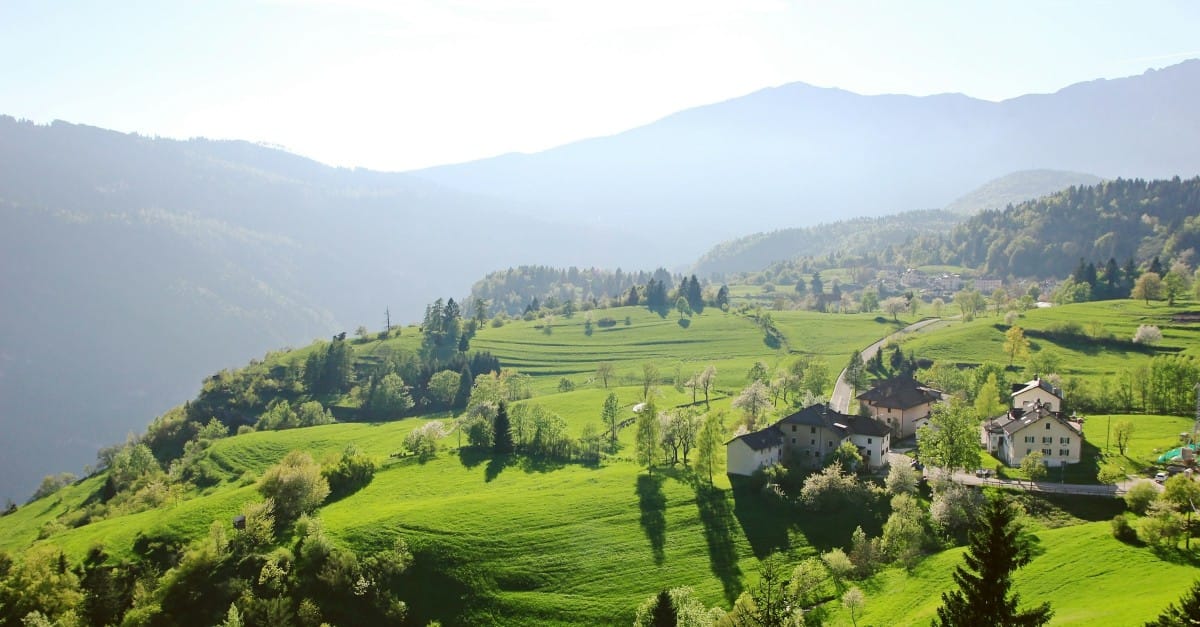
Trentino, the Autonomous Province of Trento — up to €100,000 to buy and rebuild
Here's the macro end of the ladder, and it reads like the Japan essay's recommendation turned into an open application. The Autonomous Province of Trento, up in the Dolomites, is in the process of practically applying what the Japan economist is arguing for: it picked 33 specific mountain villages losing their people and concentrated the money there. The grant runs up to €100,000 per applicant, split into €80,000 toward renovation and €20,000 toward the purchase, funded at €5 million a year and confirmed through 2026.
The 33 towns are scattered across valleys like the Val di Non, the Val di Sole, and Primiero, from Bresimo and Livo to Rabbi and Vermiglio to the ski country around San Martino di Castrozza. You have to buy in one of them, you have to actually move in or rent it out long-term, and you have to renovate to the province's standards on its timeline or repay the grant. One rule tells you what they're after: you can't already live in the village you apply for, unless you're over 45. New residents, in other words, with a pass for elder locals.
Unlike a €1 auction that appears whenever an owner offers a house, Trentino runs on scheduled windows. The next one is open from September 8 to October 23, 2026. If a €100,000 alpine renovation is the daydream, there's a date to apply.
→ See the Trentino grant details
The Fine Print
A few things from our research this week, in case you want to keep going.
The countryside doesn't stay empty. It fills back in with forest, and in Japan's case, bears. This is the b-plot, and it's the Japan essay's own Exhibit A. As farms and orchards go untended and villages thin out, Japan's bears have been coming down into towns to eat. A record 219 people were attacked in the year to March 2024, six fatally, and more than 9,000 bears were trapped and culled, aka killed. The people who do that culling are a shrinking, aging band of hunters: Japan issued about 218,500 hunting licenses in 2020, down from 517,800 in 1975, and roughly 60% of holders are over 60. The pay is nominal. One hunter told Reuters a shooter gets about ¥8,000, around fifty dollars, for a bear, barely enough for fuel. Another said training a new generation would take three to five years, "by then, we'll all be retired." In the video interview, an 84-year-old still-active hunter who once had a bear's teeth in his skull tells it straight: unless the work pays enough to support a family, young people will not take it up.
Can a foreigner buy in Italy? Yes. Italy places no nationality bar on buying property. You'll need a codice fiscale (the Italian tax ID), a local bank account in practice, and a notary for the deed. For the one-euro programs specifically, the price is the least of it: the binding parts are the renovation deadline (commonly three to four years), the surety deposit you forfeit if you miss it, and the fact that renovation costs are the actual price of entry. Budget for the works, not the euro.
Buying an akiya in Japan is a different animal. Most akiya are handled through municipal "akiya banks," and the whole point of those banks is to get people to move there, so many will not sell to someone still living overseas, and you generally register with the town yourself before you can inquire. There's also no nationality bar on owning property in Japan, but ownership is not residency, and a house is not a visa. Treat the akiya bank house as the reward at the end of a relocation decision, not the start of one.
The Trentino grant, in one place. Up to €100,000 per applicant (€80,000 renovation + €20,000 purchase), across 33 selected mountain municipalities, €5 million funded for 2026. You must buy in an eligible town, establish residency or a long-term rental, and renovate on the province's timeline or repay it; you can't be a current resident of the town unless you're over 45; up to three properties each. Applications run in windows, and the next is September 8 to October 23, 2026. Read the official provincial bando fine print before committing.
Lifestyle & Culture Notes
Wait — who pays who, again??
If you spent this week reading revival schemes the way we did, you start to notice they aren't even remotely the same. They're a whole ecosystem of arrangements, each with a different animal paying a different animal for a different reason. Confusing! And a fascinating culture study.
A field guide, for the amateur spotter.
The Symbolic Sale (Mussomeli, Pignone). A private owner sells a ruin to you for one euro. What the owner wants: to stop paying tax on a collapsing building. What the town wants: your renovation money spent locally and your name on the residents' roll. What you want: a house. Everyone is paying in a currency that isn't the euro, which is why the euro is only one.
The Renovation Grant (Trentino). A province hands you up to €100,000 to buy and rebuild in one of 33 villages it has hand-picked. What the province wants: new residents in specific towns, not just anywhere. What it fears: that you'll take €80,000 in renovation money and flip the place, which is why the residency and repayment strings are short. Native range: high, cold, beautiful, isolated and remote.
The Relocation Bounty (see the reading list). An American town writes a remote worker a check to relocate. What the town wants: your out-of-state salary spent on Main Street. Coloration nearly identical to the Renovation Grant, but found in a different hemisphere and accompanied by a press release.
The Public Rebuild (Massachusetts, Korea). No one pays you anything. The state pays a developer, tax credit by tax credit, to turn an empty mill into apartments. Least charismatic of the species, largest by mass. Seems like this is the American version of what the Japan essay is asking for.
The thing they all share is that every one of them is asking for places to be livable and thriving. Trouble is, it's a capitalist jungle out there and it seems like as a species, we are mostly either focused on the forest or the trees, when we need to be looking at the larger, global picture with a planet-friendly eye. Bears deserve to thrive just as much as humans do. The bears, for their part, are not torn between the forest and the trees. They're too busy casing your garden.
Recipes from the Map
One from each country, both the kind of thing you'd cook while the roof is being redone.
Japanese curry rice via Chopstick Chronicles — comfort food that fits our Tottori house perfectly, because Tottori is, allegedly, one of the most curry-devoted places in Japan.
Pasta alla Norma via Great Italian Chefs — the Sicilian classic of fried aubergine, tomato, basil, and salted ricotta, said to be named for Bellini's opera. The thing to cook in a half-renovated Mussomeli kitchen while the plaster dries.
What we're reading
- Japan Rural Depopulation Is No Longer a Rescue Mission, via The Economy. The macro anchor for this whole issue: the case for triage over "symbolic revival," nine million empty homes treated as a bookkeeping problem, and the bear crisis cited as proof that retreat without a plan makes new problems.
- Healey-Driscoll Administration Awards $18.6 Million to Create 662 New Homes in Gateway Cities, via Mass.gov. The public-rebuild species in the wild: a US state using tax credits to turn empty historic buildings in six mid-size cities into hundreds of apartments.
- Jeonnam-Gwangju Wins Most State Funding Nationwide for Rural SOC, via Seoul Economic Daily. South Korea's version of choosing where to concentrate: one region winning the biggest slice of national money to build "living infrastructure" in seven rural districts, one of them with an aging rate near 50%.
- Study Examines Increase in Migration from Cities to Rural Areas in La Araucanía, Los Ríos and Los Lagos, via El Ciudadano. The bottom-up counter-current: a Chilean study finding urban families choosing the countryside for cost and quality of life, reversing decline in specific communes without a single government program.
- Erice: tourism rebounds but the historic centre remains at risk, via inItaly. The tension itself, in one Sicilian hill town: paid visits up more than 80% this year, and the historic center still emptying of actual residents, with more houses going up for sale.
Live from our group chat
This is the part where we tell you what the rabbit hole looked like for us this week.
Malia: Trentino will give me a hundred thousand euros. Eighty to renovate, twenty to buy. I have already chosen the village. It has forty people, and we both know one of them will likely become my Italian nemesis.
Wally: In Mussomeli, ten Argentine doctors moved in and kept the hospital running. Just imagine what one American with a hundred grand and no medical training could do.
Malia: Sounds like a recipe for drama. Meanwhile the Japan house is nineteen thousand dollars for a place the size of an inn, in mountains where the bears are becoming increasingly active as the trained hunters age out of the profession.
Wally: So: Trentino for the money, Sicily for the doctors, Tottori for the bears. Guess we'll take one of each.
That is issue nine. Thanks for reading.
Until next week, Wally & Malia
Remnant is a weekly newsletter about distressed and beautiful houses around the world. We are not real estate agents. We just got a little obsessed and started digging. What will you do with what we find?